












Why More Commands Make Golden Training Harder
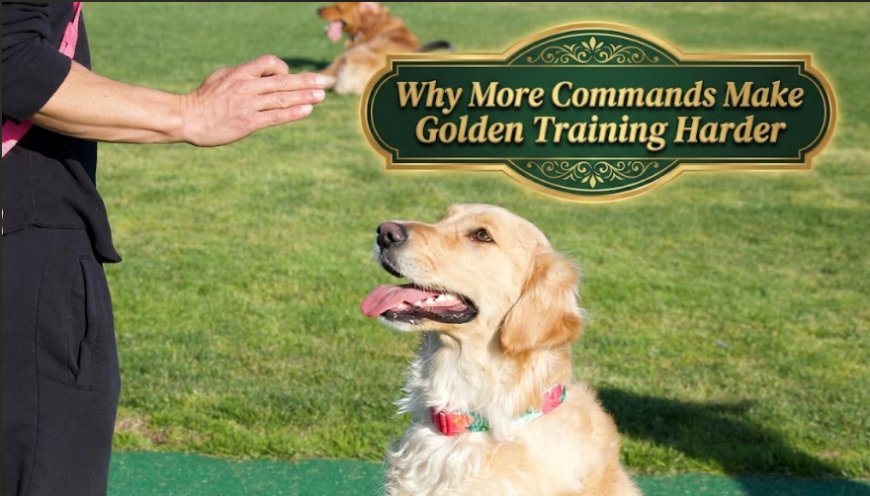
A Golden who knows fifteen commands and performs twelve of them sometimes is not better trained than a Golden who knows five and performs all of them every time.
That took me longer to accept than it should have. With Ellie, I spent the first several months adding new behaviors constantly because it felt productive, and because she'd pick something up quickly in a session and I'd feel like we were making real progress. The list got long. The reliability didn't match it. She'd perform beautifully in the kitchen on a quiet weekday morning, and completely fall apart at the park when there was a squirrel visible anywhere in a fifty-yard radius.
The impulse to teach more comes from a good place. It looks impressive. But training isn't about the list. It's about what holds up.
1. The Belief That's Getting In The Way
Most owners operate on an assumption they've never really examined: that a command is learned once the dog performs it at home. In a quiet room, with no distractions, with treats visible. That's the bar, and it's not a very high one.
Dogs don't generalize automatically. This is the piece that surprises people. Learning "sit" in your kitchen doesn't transfer cleanly to "sit" on a busy sidewalk or "sit" next to a dog they want to greet. Every new location, new distraction level, and new distance is functionally a new version of the behavior from the dog's perspective. A behavior practiced only in one place, at arm's length, with consistent treat delivery is not a trained behavior. It's been introduced.
And the myth built on top of that shaky foundation is that adding more commands makes a more capable dog. What it actually makes is a dog with a long menu of behaviors that none of them hold up when it counts.
2. What Fluency Actually Means
The word trainers use is "fluency." A fluent behavior is one the dog performs immediately, reliably, and automatically, in any reasonable context you ask for it. No deliberation. No second look at your hands. No checking whether you look serious. Just the behavior, clean and fast.
Getting to fluency means working through what's sometimes called the three Ds: duration, distance, and distraction. Can your dog sit for thirty seconds without breaking? Can they sit when you're across the room? Can they sit when a stranger walks past? Each of those is a separate dimension of training, and each one has to be worked deliberately before you've actually trained the behavior to a level that's useful.
Goldens are fast learners in controlled settings, which is part of why this problem shows up with this breed specifically. They pick up new cues quickly in a quiet room, and that creates a convincing illusion of progress. But quick acquisition and actual fluency are different things. The behavior has been introduced. The real training work is still ahead.
3. What Happens When You Add Too Much Too Fast
Training sessions start to feel like a pop quiz the dog wasn't fully prepared for. Performance drops, not just on new material but on behaviors the dog has been doing for months.
There's also a quieter cost that's easy to miss. Adding commands before the existing ones are solid trains the dog to treat cues as approximate. If "sit" has sometimes produced results and sometimes hasn't, if the standard for response has been inconsistent, the behavior stays soft. Precision in response comes from precision in training. A dog who learns to respond reliably every time, because every time meant something, is a different dog from one who learned that responding sometimes is usually enough.
Going back later to tighten a behavior that was practiced messily takes significantly longer than building it correctly the first time. I know this from Ellie's recall. She'd come reliably inside, so I moved on before that reliability existed anywhere else. The outdoor recall was inconsistent for months, and I spent much more time rebuilding it than I would have spent if I'd proofed it properly from the start. A lesson I wish I'd learned a year earlier.
4. The Depth-Over-Breadth Approach
The actual shift is simple: go deep before you go wide.
Pick a small set of behaviors and take each one to genuine fluency before introducing anything new. And "fluency" has a specific meaning here, not "performs it when I ask nicely in the living room." The standard is higher than that.

Here's a plain-text checklist to use as a benchmark. If you can't check most of these, the behavior isn't done yet:
IS THIS COMMAND ACTUALLY TRAINED? (Checklist)
[ ] Dog responds within 2 seconds of hearing the cue, no repeat needed [ ] Dog performs it in at least 3 different locations outside your home [ ] Dog performs it when you are 10+ feet away [ ] Dog performs it with a person, dog, or moderate noise nearby [ ] Dog performs it 9 out of 10 times with no food visible in your hand [ ] Dog holds position behaviors (stays, downs) for at least 30 seconds [ ] Dog performs it reliably at the start of a session AND when mentally tired mid-session
If most of those don't apply yet, the behavior isn't ready to set aside. That's not a slow dog. That's where the work actually lives.
Golden Retriever Info's new puppy checklist covers what a well-structured foundation looks like in the first weeks and months, and the training expectations there align with this same principle: doing fewer things properly rather than many things loosely.
5. The Five Worth Doing First
Not all behaviors have equal value. These five form the foundation that everything else gets built on. If these are genuinely fluent, every behavior you add afterward clicks in faster.
Sit. The reset behavior. Ask for it before your dog gets anything they want: food, play, going through a door. A reliable sit is the behavior you reach for when your dog is over-aroused and you need a pause. Work it everywhere.
Down. Harder than sit for most Goldens because it requires more submission and stillness. Critical for extended calm, vet visits, and any situation where you need your dog settled for longer than thirty seconds.
Stay. This is the one most owners rush through. A sit-stay that lasts five seconds is a starting point, not a finished behavior. Build duration incrementally. Work up to five solid minutes with you out of the room before you call it trained.
Come. The recall. Probably the most important behavior in terms of safety and yet consistently the most undertrained, because people practice it in easy conditions and call it done. Work the recall in every environment, at every distraction level. It's the one that matters most when something unexpected happens.
Leave it. Goldens eat things they shouldn't. A fast, automatic leave-it response is the behavior you want wired in before you ever genuinely need it. And you'll genuinely need it.
This is also the foundation covered in the potty training timeline guide, not for the potty training itself but for the broader point it makes about consistent repetition producing reliable behavior over time. That consistency principle applies across everything above.
6. How To Structure Sessions Around This
Short sessions. One or two behaviors per session, maximum. Five to ten minutes. End before the dog's focus drops, not after.
A session where you work sit and only sit, running twenty solid repetitions across different positions, distances, and contexts within your living room, does more for your Golden's actual training than a forty-five-minute session rotating through ten behaviors with inconsistent outcomes.
One structural habit worth dropping: starting every session by running through all the behaviors the dog already knows as a warm-up. It sounds reasonable. But it uses up the dog's best focus on behaviors that don't need more repetitions, and by the time you get to the harder material, they're already starting to drift. Work the harder or newer behavior first. Use familiar cues as a reward at the end.
And the mental engagement piece is real. A Golden who gets structured cognitive work from training sessions is less likely to invent their own stimulation elsewhere. The piece on why Golden puppies chew everything in sight gets at this: an outlet-seeking dog is frequently an under-stimulated dog. Focused training addresses that need directly.
FAQs
My Golden puppy picks up new things really fast. Doesn't that mean I can move quickly through material?
Fast acquisition and true reliability are different processes. A puppy who figures out "shake" in a single session has learned the rough movement pattern in one context. That's the introduction phase. The fluency-building phase, which is the longer and more important part, hasn't started yet. Moving quickly through introductions just means you get to start the real work sooner, not that the real work is done.
How many commands should a one-year-old Golden realistically know?
A one-year-old with five behaviors trained to genuine fluency is better positioned than a one-year-old with twenty behaviors at inconsistent reliability. A Golden trained consistently from puppyhood can have sit, down, stay, come, leave it, go to place, and several additional behaviors well established by a year, but only if those were worked properly. Quality is the variable that matters. Count is not.
I've already taught my Golden a lot of commands and none of them are very reliable. How do I fix this?
Pick the three behaviors most useful in your daily life with your dog and rebuild them from scratch as if they're brand new. Systematic proofing across different environments, distances, and distractions. Put the other behaviors aside temporarily. Once those three are solid, move to the next most useful. It feels like going backward. The foundation you build will be real this time.
What about tricks? Is it worth teaching fun stuff even if the foundational behaviors aren't solid yet?
Tricks are good for enrichment and bonding, but they're a different category from trained behaviors. A Golden who knows "spin" and "wave" practiced occasionally for fun isn't being held to the same fluency standard as a recall. Keeping those categories separate in your head works fine. Where it goes wrong is when trick training replaces foundation training because tricks feel more fun to teach and the dog picks them up quickly.
My Golden performs commands perfectly when I have treats, then ignores me when I don't. What's going wrong?
The behavior was trained to the treats, not to the cue. This happens when food appears before the behavior rather than after it, or when the dog only sees the cue in food-present conditions. Fix it by working without food visible in your hand from an early stage, and by making the treat appear from a pocket after the behavior rather than from your hand before it. The cue should predict the reward, not the presence of food.
Goldens genuinely want to engage with training. The eagerness is built in. But that same eagerness can mask fragile behaviors because the dog performs them enthusiastically even when the reliability isn't there yet. Staying with each behavior longer than feels strictly necessary is almost always the right instinct.
More training content for Golden Retrievers, including guides on adolescent behavior and building consistent responses, is collected over at Golden Retriever Info's training section.
What's Your Reaction?
 Like
0
Like
0
 Dislike
0
Dislike
0
 Love
0
Love
0
 Funny
0
Funny
0
 Angry
0
Angry
0
 Sad
0
Sad
0
 Wow
0
Wow
0