










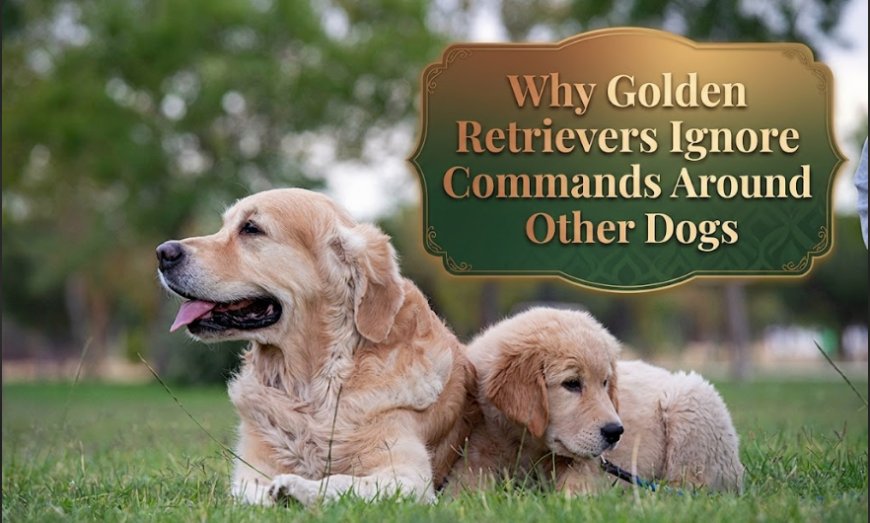
Why Golden Retrievers Ignore Commands Around Other Dogs
When Ellie was around eight months old, I was genuinely proud of how far she'd come. She sat on cue, came when called, and held a stay at the edge of the kitchen while I prepared her food. I had put in real time with her. Consistent sessions, proper rewards, same commands every time. So the first afternoon I took her to a local park and watched her completely blank me the moment she spotted another dog forty feet away, I was confused.
Not frustrated. Confused. She wasn't acting up in any way I recognised. She just stopped registering that I was there. I said her name. I said sit. I said it again. She was watching a yellow Lab across the grass with the focus of someone watching a house fire, and I was apparently furniture.
I spent a few weeks convinced the problem was something I was doing wrong in the moment. Not firm enough, not engaging enough, not using the right treat. The actual explanation turned out to be simpler and more useful than any of that, and it's something we try to address clearly here at Golden Retriever Info rather than just offering the standard "be more consistent" advice that doesn't actually explain anything.
1. Your Golden Hasn't Forgotten How to Listen. They've Hit Their Threshold.
Every dog has what trainers call a threshold, the point at which arousal or excitement climbs high enough that the dog can no longer respond to cues, regardless of how well-trained they are. Past that threshold, the parts of the brain responsible for learned behaviour become less accessible. What's running the show instead is the more reactive part of the brain that processes excitement, social drive, and biological impulse. That's not a metaphor. It's a reasonably accurate description of what's happening neurologically when your Golden fixates on another dog and goes offline.
Other dogs are one of the highest-value triggers that exist for a Golden Retriever. The pull toward another dog isn't defiance and it isn't selective hearing. It's a biological drive reinforced by every positive social interaction they've ever had. When Ellie locked onto that Lab across the park, she wasn't making a choice to ignore me. She was past the point where choice was really the operating mechanism.
This reframe is the first genuinely useful thing I learned, and it's a gap that comes up in a lot of questions we see at Golden Retriever Info. The question isn't "why won't she listen?" The question is "at what distance does she hit her threshold, and am I training at a level where she can actually succeed?" Once you ask it that way, the problem changes shape entirely.
Here's something worth knowing that gets skipped over often: the threshold isn't a fixed line. A dog who slept poorly, skipped their morning walk, or is coming into a session already keyed up will hit threshold faster and closer than usual. A dog who's well-exercised and settled beforehand has more capacity to stay focused. Ellie on a morning where we'd already done a long walk and she'd eaten was a different training partner than Ellie at 4pm who'd been inside since 8am. Not dramatically different, but enough that it changed what was realistic to expect from the session.
2. "Sit" at Home and "Sit" at the Park Are Not the Same Command
This is the part that caught me completely off guard, and I think it catches most owners off guard too. We assume that once a dog knows a command, they know it. That's not how dogs learn.
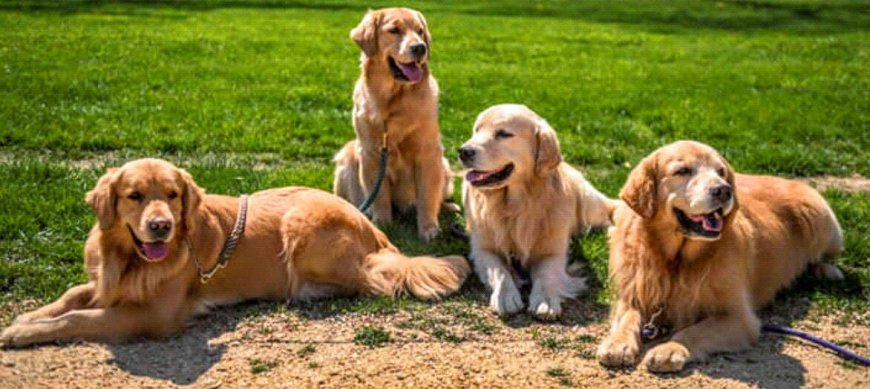
Dogs learn in context. "Sit" practised in the kitchen, with familiar smells, a quiet environment, and a calm handler, is a highly specific piece of learning. It's not a universal concept of "sit." It's "sit in this room, with this person, when nothing interesting is happening." When you say "sit" outdoors with unfamiliar smells, wind, movement, and a dog running 30 feet away, you're asking your Golden to perform a harder version of that same word in a situation they've never actually been trained in.
Professional trainers call the process of teaching a command across environments proofing. It's deliberate and sequential, and the steps matter. You don't go from the living room to the dog park. You go from the living room to the backyard to the front yard to a quiet street to a busier street to a park with no other dogs to a park with distant dogs to a park with closer dogs. Each step increases the distraction load, and you only move forward when the response at the current level is easy and consistent. Not perfect, just easy.
Most owners, completely understandably, skip the middle. I trained Ellie at home until she was reliable, then took her to one of the most distracting environments possible and expected the same results. That was my mistake, not hers. And looking back, it seems obvious. But when you're in the middle of it, it just feels like your dog is being difficult, and it's hard to separate what's actually happening from what you're assuming.
This also explains something a lot of Golden owners mention: their dog responds at 50 feet but not at 20. That's not inconsistency. That's the threshold effect intersecting with a proofing gap. The command exists in their understanding. It just hasn't been taught at that level of distraction yet.
3. Building Commands That Actually Hold Up When Another Dog Is Around
The practical approach that works is to start where your Golden can succeed, not where they currently fail, and raise the challenge in small, deliberate increments.
Start by identifying your Golden's threshold distance with another dog. Watch for the moment they stop being able to look at you and respond, and call that your working distance. If your dog fixates and stops responding at 15 feet, your starting point is 25 feet. Build your responses there first: a reliable sit, a reliable recall, sustained eye contact. Once those are easy and quick, move to 20 feet. Then 15. The distance matters because you need your dog working below threshold to actually build the learning. Reps above threshold don't teach much except that ignoring you is viable.
Reward value has to scale with challenge level. The kibble or biscuits that work at home won't always cut it when another dog is nearby. Ellie would look straight through kibble in that situation, it simply wasn't worth the competition. Small pieces of real cooked chicken, cheese, or hot dog are a different conversation. The reward needs to be worth more to your dog than the alternative, and at high-distraction levels, the alternative is extremely appealing. Use whatever your specific dog finds hardest to walk away from.
One thing I found really useful was rewarding Ellie for checking in with me voluntarily around other dogs, not for obeying specific commands, just for choosing to look at me when another dog was in the picture. Any time she redirected her attention back to me unprompted, that got a high-value reward immediately. Over several months this built a loop: the presence of another dog started to predict that looking at me was worth something, rather than predicting that I was about to become irrelevant. It's a subtle shift but it changes the whole dynamic.
The Golden Retriever Training section of Golden Retriever Info covers more of the engagement-building side of this, and it's worth reading alongside what's here.
One honest note: patience isn't a suggestion in this process. Ellie didn't flip a switch. Progress was inconsistent, there were weeks where it felt like regression, and then sessions where everything came together in a way that made the previous month make sense. That's a normal pattern. The dogs who end up genuinely reliable around other dogs were trained there, not just brought there and hoped at.
4. The Patterns That Make This Harder to Fix Over Time
A few things that owners do without realising they're doing it that compound the problem.
Repeating the command. If Ellie didn't respond to "sit" the first time, my instinct was to say it again, louder. What that actually taught her was that the command was optional the first time, or possibly the second time, and she'd know I meant it when my tone changed. Repeating an ignored cue trains the dog that non-compliance is a reasonable first response. Ask once. If there's no response, either help them physically (gentle guidance into position) or move them away from the distraction and try again at a lower intensity. Don't repeat until they respond.
Letting the other dog be the reward for ignoring you. If your Golden ignores a command, pulls toward another dog, and then gets to greet them, what just got reinforced is: ignore the handler, get the thing I wanted. The learning happened even though it wasn't the intention. Managing this means being thoughtful about when dog greetings happen in relation to what preceded them. The goal isn't to prevent socialisation. It's to make sure compliance and reward are associated.
Moving to harder environments before the foundation is solid. Taking your Golden to a busy dog park before they're reliable at lower distraction levels doesn't build resilience. It builds a history of ignoring you in the presence of other dogs, because that's what's happened, repeatedly, in that setting. Every ignored command that isn't addressed is a rep of a different lesson than the one you intended to teach.
Not accounting for your dog's state going in. A Golden entering a session already at elevated arousal, maybe from hearing something outside, or because there's a dog visible from the yard, will hit threshold much faster than one who's calm. A five-minute settle before a training session, or a short decompression walk, can make a real difference in what you're able to accomplish. It's not about tiring them out. It's about bringing arousal down to a workable level before you start.
The table below is useful for understanding why performance drops so sharply around other dogs, because the gap between training at home and training in that context is wider than most people expect.
| Factor | Training at Home | Training Near Another Dog |
|---|---|---|
| Arousal level | Low to moderate | High to very high |
| Dog's available attention | Near full | Significantly reduced |
| Reward required | Standard treat or kibble | High-value food: meat, cheese |
| Typical command success rate | 80-95% for practised commands | Can drop to 10-40% without prep |
| Where to start working | Wherever is convenient | Several feet past threshold distance |
| What builds reliability | Consistency and repetition | Distance management and proofing |
This table also answers something I got in a message from a reader once: "My Golden is perfectly trained at home, why does she act like she forgot everything at the dog park?" She didn't forget anything, the dog park is just a harder exam than the living room, and she'd never specifically studied for it.
FAQs
1. My Golden responds well at home but the second we see another dog, she shuts down. Is this a training failure or just her personality?
It's a training gap, not a personality issue. Your Golden knows the commands in the context where they learned them. They haven't been taught to perform those commands under the specific distraction of another dog. That's a proofing issue, not a character one, and it's fixable. The Golden Retriever Puppy Week One Surprises article touches on how much those early experiences shape what dogs find manageable later on, which is useful background context.
2. At what age do Golden Retrievers typically get reliable around other dogs?
There's no standard age. It depends entirely on how much structured work has been done at progressively harder distraction levels. Some Goldens with consistent proofing reach reliability around distractions by 12 to 15 months. Others take longer, particularly if their early socialisation window (roughly 8 to 16 weeks) involved limited exposure to other dogs. Older Goldens can absolutely learn this. Age doesn't cap the ability. Proofing history does.
3. Is it true that Goldens are harder to train around other dogs than other breeds?
In a practical sense, yes, often. Goldens were developed to be highly socially motivated and extremely interested in their environment. Other dogs represent one of the highest-value rewards possible for this breed. That drive toward social engagement is part of what makes them wonderful dogs and part of what makes this particular training challenge real. It's not a flaw. It's the breed doing what it was built to do.
4. My Golden knows "leave it" but can't apply it when a dog is running near us. Am I using the wrong technique?
The technique is probably fine. The issue is that "leave it" with a running dog at close range is one of the hardest applications of that command, well past where most owners first teach it. The same impulse control foundation that makes "leave it" possible is what gets trained gradually through the process covered in why Golden puppies bite absolutely everything, and it needs to be proofed in stages with other dogs the same way any other cue does. Start practising "leave it" with other dogs at a large distance and close gradually over time.
5. Should I correct my Golden when they ignore me around another dog, or just ignore it and move on?
The main thing to avoid is repeating the command while nothing changes and eventually giving up, because that sequence teaches the dog that commands are negotiable. Beyond that, most trainers working in this area recommend against punitive corrections at high-distraction moments, partly because the dog is often past threshold and corrections add stress without teaching much. More useful approaches: move them away from the distraction and try again at a lower intensity, or wait for a moment of attention and reward that. If stress responses are part of what you're seeing, the Golden Retriever Health section covers the connection between stress and training receptiveness in more depth.
Ellie is reliable around other dogs now. Genuinely. I can call her off of fixation, maintain her attention during a passing dog, and ask for commands at close range and get them. It took longer than I expected and the progress was not a straight line. But the work was specific and it was at the right level of challenge, and that made it stick.
What I'd pass on is this: if your Golden checks out around other dogs, the problem is almost never attitude. It's almost always that they've been asked to perform at a level they haven't been prepared for. That's a much more solvable problem, and it starts with understanding where their threshold actually is and working from there, not from where you wish it was.
Over at Golden Retriever Info, we try to give you the practical reasoning behind these moments, not just the surface advice. Because understanding why something works is what makes it repeatable.
What's Your Reaction?
 Like
0
Like
0
 Dislike
0
Dislike
0
 Love
0
Love
0
 Funny
0
Funny
0
 Angry
0
Angry
0
 Sad
0
Sad
0
 Wow
0
Wow
0