



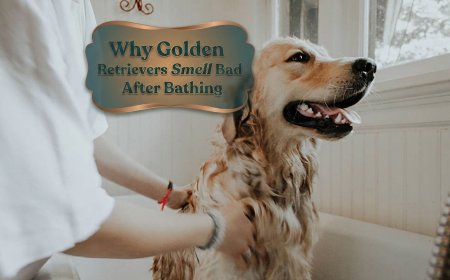






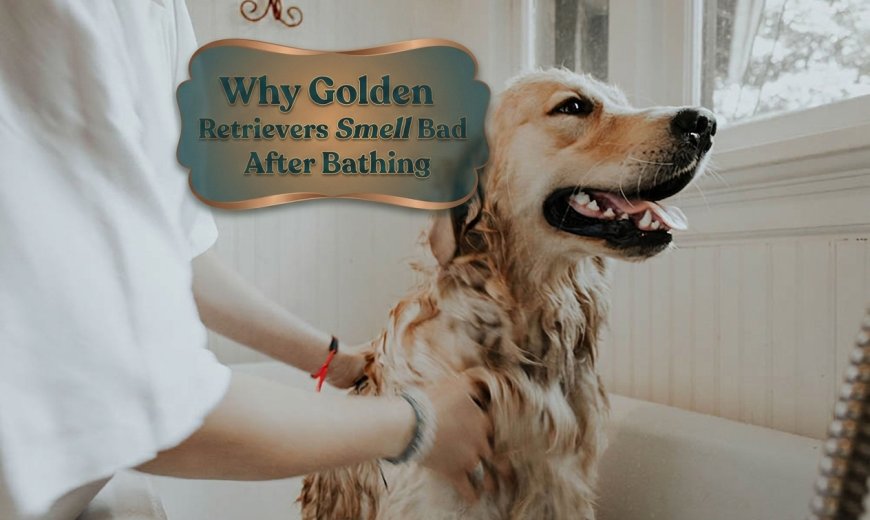
Why Golden Retrievers Smell Bad After Bathing
Ellie used to smell worse the day after her bath than she did before it.
I noticed this early on and assumed I was doing something wrong. Bad shampoo, maybe. Not rinsing thoroughly enough. I tried different products, changed my technique, bought the expensive shampoos from the pet store that claimed to be formulated specifically for double-coated breeds. The smell was still there the next morning, hanging in whatever room Ellie had settled into overnight.
It took me longer than I'd like to admit to understand what was actually going on, and it wasn't one single thing.
1. The Double Coat Problem Nobody Explains Properly
Golden Retrievers have two distinct layers of fur. The outer guard coat is composed of longer, coarser hairs that naturally repel water. The undercoat is a dense, soft layer packed close to the skin that provides insulation. When you wet a Golden during a bath, the guard coat gets soaked, but the undercoat can stay partially wet for a surprisingly long time, and when it does get thoroughly wet, it holds moisture against the skin in a way that a single-coated dog simply doesn't experience.
That trapped moisture is where the smell comes from.
Every dog's skin carries a natural population of bacteria and yeast. Malassezia pachydermatis is a yeast species that lives on the skin of all healthy dogs, and certain bacteria are always present in the coat as well. Under normal conditions, these microorganisms are harmless and largely odorless. But give them warmth and sustained moisture, which is exactly what a partially dried Golden Retriever undercoat provides for hours after a bath, and they produce volatile organic compounds that create that musty, sour wet-dog smell. And in Goldens, the smell can be intense because the undercoat is so dense and holds onto moisture so well.
The mistake I see most often is owners drying the outer coat until it looks dry and feels dry to the touch, then considering the job done.
The outer coat dries first. Always. The undercoat can still be holding significant moisture that you cannot see, and can barely feel unless you push your fingers all the way to the skin.
2. Normal Post-Bath Smell Versus Something Worth Paying Attention To
Not every post-bath odor signals a problem. There's a spectrum, and knowing where your Golden falls on it determines whether you adjust your drying routine or call your vet.
Comparison: Normal vs. Concerning Post-Bath Smell in Golden Retrievers
Smell Type              | Likely Source                    | What to Do
------------------------|----------------------------------|---------------------------
Mild, musty, fades      | Damp undercoat; normal           | Dry the undercoat
within a few hours      | microbial activity               | more thoroughly
------------------------|----------------------------------|---------------------------
Strong, sour or yeasty  | Undercoat stayed wet too long;   | Blow-dry to the skin;
even after coat is dry  | possible yeast overgrowth        | check skin for redness
------------------------|----------------------------------|---------------------------
Fishy or strong         | Anal gland expression during     | Check anal glands;
metallic odor           | bath; anal gland issue           | vet if persistent
------------------------|----------------------------------|---------------------------
Musty smell from        | Water in ear canal; ear          | Dry ears after bath;
the ears specifically   | infection developing             | vet visit if ongoing
------------------------|----------------------------------|---------------------------
Foul smell from skin    | Hot spot, bacterial skin         | Part the coat and inspect
when coat is fully dry  | infection, or seborrhea          | skin; vet evaluation
The distinction that matters most is simple: does the smell disappear once the coat is fully, genuinely dry, or does it persist? If Ellie smells noticeably off two days after a bath when her coat should be long past any damp stage, something else is contributing. Surface-level drying won't fix a skin or ear issue.
3. Ellie's Ear Problem and What I Missed for Almost a Year
Here's the part I'm slightly embarrassed to write, but it's relevant.
For a long stretch, I chalked Ellie's lingering post-bath smell to the double coat and kept working on drying technique. My approach did improve and the smell improved somewhat. But there was still this persistent undertone I couldn't fully get rid of. I mentioned it to our vet almost as an afterthought during a routine visit, expecting to hear something about shampoo choice.
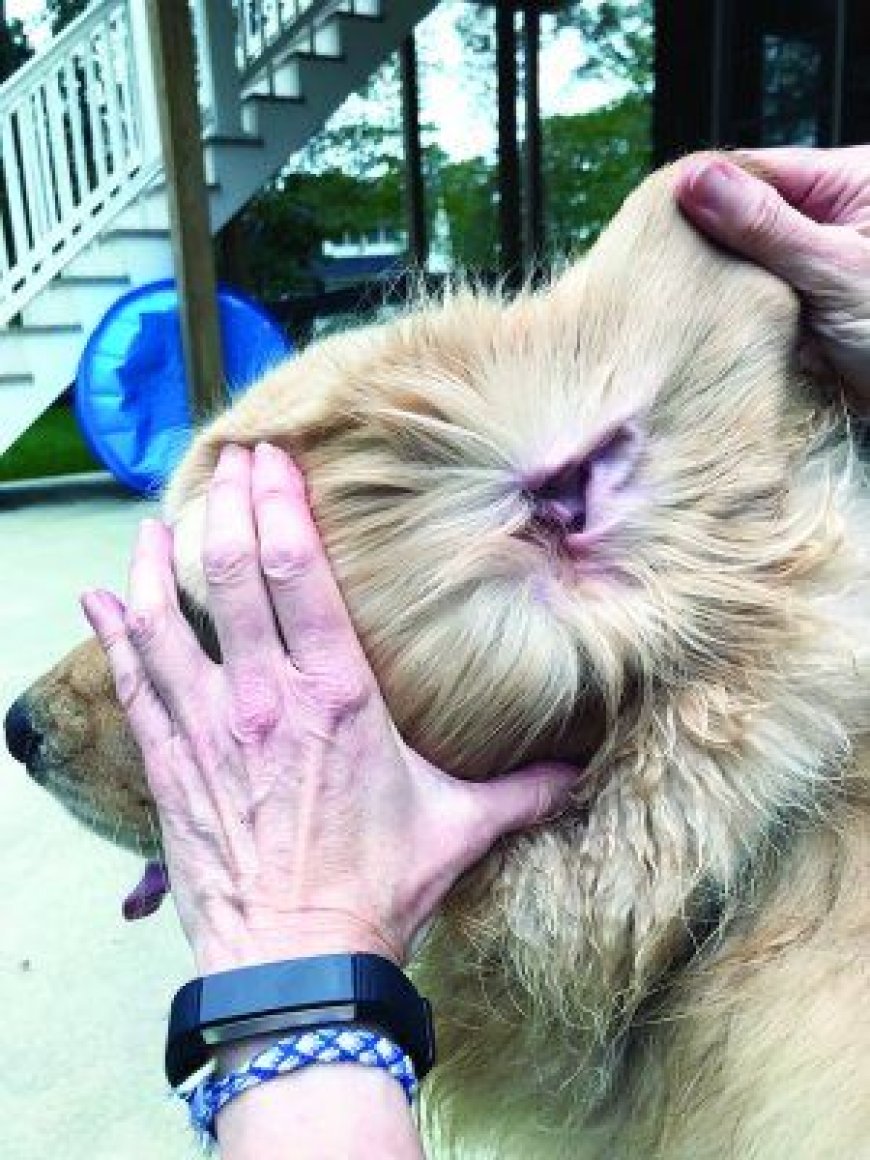
She checked Ellie's ears instead.
Ellie had a low-grade yeast infection in her left ear that I had genuinely not noticed, because it wasn't causing her visible discomfort. No head shaking, no scratching, no obvious signs. Just a faint yeasty smell that became more noticeable when her coat was wet, because moisture activates the same yeast community that was already quietly established in her ear canal.
Goldens are particularly prone to ear infections because their drop ear covers the canal and traps warmth and humidity. Bathing introduces water near the ear opening, and even careful owners get some moisture in there. For a dog with an already-irritated canal, that added moisture speeds things up. Golden Retriever Info has a detailed ear care guide that covers cleaning, prevention, and what to watch for before your dog reaches the point Ellie did [INTERNAL LINK: goldenretrieverinfo.com/golden-retriever-ear-care-guide].
The broader point isn't that ear infections cause all post-bath smell. It's that persistent or unusual smell after bathing is worth taking seriously rather than writing off as a grooming product issue.
4. Sebaceous Oils, Shampoo Choices, and the Smell Cycle That Makes Things Worse
Dogs produce skin oils through sebaceous glands attached to each hair follicle. These oils waterproof the outer guard coat and prevent the skin from drying out. Goldens produce sebaceous oils in higher quantities than many breeds, which is part of what gives their coat that characteristic sheen and water-shedding ability.
When warm bath water contacts these oils, it temporarily makes them more volatile. The compounds that make up sebaceous secretions are largely odorless at normal skin temperature, but introduce heat and dilution and you change the chemistry just enough to notice during and immediately after a bath. This is distinct from bacterial or yeast smell; it's just the natural oils reacting to temperature and water.
Using a shampoo that strips these oils too aggressively creates a different problem: the skin compensates by producing more oil. More oil production means the smell returns faster between baths and gets stronger over time. This is a cycle I've seen Golden owners fall into when they start bathing more frequently because the smell bothers them, which causes more stripping, which causes more oil production, which causes more smell. If your current shampoo leaves Ellie's coat squeaky-clean and stiff-feeling, it's probably too harsh. A shampoo formulated for double-coated breeds and pH-balanced for dogs, which differs from human skin pH, works with the coat rather than against it. Golden Retriever Info covers shampoo selection and what to look for on the ingredient label in a separate guide [INTERNAL LINK: goldenretrieverinfo.com/best-shampoo-for-golden-retrievers].
5. Getting the Drying Right
A regular bath towel is not sufficient for a Golden. Towel drying removes surface moisture from the outer coat but barely touches the undercoat. If your dog then air-dries in the house, the undercoat stays damp for hours, sometimes the better part of a day, and the smell is the result.
What actually works is a forced-air dog dryer used after initial towel drying. These push air at sufficient velocity to penetrate the undercoat and physically move moisture out from the skin up. Human hair dryers can substitute but take considerably longer; if using one, set it to the lowest heat setting and keep it moving constantly. The goal is consistent airflow, not heat.
Section the coat while you dry. Push the fur apart with a brush or your fingers and direct the airflow toward the skin, then work outward. The areas that stay wet longest are the chest, the back of the thighs, the thick fur around the collar area, and anywhere the coat is densest. These are the spots that need the most time and attention.
The belly gets missed constantly. It seems like it should dry quickly because the fur there is thinner, but it stays damp against the skin and the smell from an undried belly is very noticeable. Ellie strongly objects to having her belly dried, for the record, and I dry it anyway.
Bathing frequency matters too. Once every four to six weeks is appropriate for most Goldens without specific skin conditions. More frequent bathing strips natural oils and triggers more oil production, which tends to make the smell pattern worse rather than better. If you're bathing your Golden every two weeks because of the smell, the bathing frequency may actually be contributing to the problem.
FAQs
Is some smell right after a bath normal for a Golden Retriever?
A mild, musty odor immediately after bathing is common because of the double coat and the natural oil reaction to warm water. It should fade within a few hours as the coat dries. A strong, sour, fishy, or foul smell, or one that lingers 24 to 48 hours after the bath, points to an underlying issue worth investigating.
How do I actually dry a Golden Retriever's undercoat?
A forced-air or high-velocity dog dryer is the most effective option. Work in sections from the skin outward, and focus extra time on the chest, thighs, belly, and collar area. Human hair dryers work but take longer; use low heat only. Towel drying alone leaves the undercoat wet and sets up the conditions for that musty post-bath smell.
Could the smell after a bath be a sign of a skin infection?
Yes. If you part the coat and find red, irritated, greasy, or scaly-looking skin, or if the smell lingers well after the coat has dried, bacterial skin infection, cutaneous yeast overgrowth, or seborrhea could be contributing. These are straightforward for a vet to assess and typically visible on a basic examination.
My Golden shakes their head right after baths. Is that related to the smell?
Head shaking after a bath usually means water has entered the ear canal. In Goldens, this matters because moisture in a warm, covered ear canal creates conditions where yeast and bacteria proliferate easily. Yeast ear infections produce a distinct sweet or musty odor that can be mistaken for general post-bath smell. Drying the outer ear with a cotton ball after every bath helps, and your vet can recommend an ear-drying solution if your dog is prone to repeated ear issues.
How often should I bathe my Golden Retriever?
Once every four to six weeks is a reasonable guideline for a Golden without an active skin condition. Bathing more frequently strips the natural oils that protect the skin and coat, and the skin responds by overproducing oil, which creates a smell cycle that's hard to break. Dogs that swim regularly or spend significant time outdoors may need more frequent bathing, but thorough drying matters every single time.
The smell improved significantly once I committed to actually drying Ellie's undercoat rather than just the parts of her I could easily reach with a towel. The ear infection was a separate issue that needed a vet, and I'm glad she caught it even if I needed prompting to mention the smell at all.
If the drying isn't the answer, start with a vet conversation. The smell usually has a specific source, and once you find it, the fix tends to be straightforward.
What's Your Reaction?
 Like
0
Like
0
 Dislike
0
Dislike
0
 Love
0
Love
0
 Funny
0
Funny
0
 Angry
0
Angry
0
 Sad
0
Sad
0
 Wow
0
Wow
0