











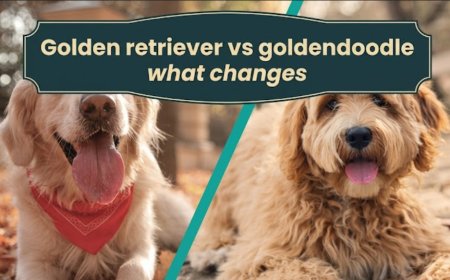




Golden retriever vs goldendoodle what changes

A lot of people picture a goldendoodle as a golden retriever that just happened to get a perm. Same dog, curlier coat, slightly less shedding, done. That's not really what's going on, and the gap between those two dogs is bigger than coat texture once you look past the surface.
A goldendoodle isn't a breed in the way a golden retriever is. It's a cross, usually golden retriever and poodle, and depending on the generation and the specific dogs involved, that cross can land anywhere on a fairly wide spectrum. Comparing the two isn't really golden versus goldendoodle so much as golden versus "it depends."
1. Coat and Shedding: The Part Everyone Gets Wrong First
Golden retrievers have a predictable double coat. Dense undercoat, longer guard hairs, seasonal blowouts twice a year, moderate shedding the rest of the time. You know what you're signing up for before the dog even arrives.

Goldendoodles are a different story entirely. An F1 doodle, first generation, golden crossed directly with poodle, can come out with anything from a loose wavy coat that sheds noticeably to a tighter curl that sheds very little. F1b doodles, bred back toward poodle, tend to land closer to the low-shedding end, but "tend to" is the key phrase. Coat outcome in a single litter can vary puppy to puppy even with the same parents.
And this is where the hypoallergenic claim falls apart a little. No dog is truly hypoallergenic. The allergens people react to live in saliva and skin dander, not just loose fur, so a low-shedding doodle coat reduces airborne hair around the house but doesn't eliminate the allergen itself. Families assuming a doodle solves a dog allergy outright are sometimes disappointed a few months in, after the breeder paperwork promised more than biology can actually deliver.
2. Size and Predictability
A golden retriever's adult size is about as predictable as dog breeding gets. Standard weight and height ranges, minimal surprises.
A goldendoodle's size depends entirely on which poodle was used. Standard poodle crosses land in roughly the same size range as a golden. Miniature poodle crosses produce a noticeably smaller, lighter-framed dog with a different exercise tolerance and different joint considerations. This single variable changes more about the dog's day to day needs than people realize when they're shopping by photos online rather than asking which poodle size was actually in the pairing.
I get asked the difference between these breeds constantly through Golden Retriever Info, and the size question comes up more than almost anything else. People see an adorable mini doodle puppy photo and end up with a forty pound dog, or the reverse, and the surprise is almost always traceable back to not asking about the poodle parent's size up front.
3. Temperament: Same Roots, Different Expression
Both dogs come from genuinely friendly, people-oriented stock, so the baseline temperament overlap is real. Where things diverge is in how that friendliness gets expressed once poodle intelligence and sensitivity get mixed in.

Poodles are sharp, and that sharpness carries into a lot of doodle lines as a need for mental engagement that goes a bit beyond what a typical golden requires. A bored, understimulated doodle can develop anxious or fixated behaviors faster than a golden in the same situation tends to, partly because the dog is processing more and has fewer outlets for it if the household isn't built around that. None of this makes one temperament better than the other. It just means the training and enrichment plan that works fine for a golden sometimes needs an extra layer for a doodle, more puzzle feeding, more novel tasks, less tolerance for routine boredom.
4. Health and Lifespan: What the Cross Actually Changes
Golden retrievers carry a well documented elevated cancer risk, something researchers through the Morris Animal Foundation's long running Golden Retriever Lifetime Study have been tracking for years specifically because the rate is high enough in the breed to justify dedicated research. This isn't a guess or a scare tactic, it's one of the more studied health patterns in purebred dogs.
Crossing with a poodle introduces what's sometimes called hybrid vigor, more genetic diversity that can reduce the odds of certain heritable conditions showing up, hip dysplasia being one example people point to often. But hybrid vigor isn't a guarantee, and a poorly bred doodle from two unhealthy parents inherits problems just as easily as a poorly bred purebred does. The cross doesn't erase risk. It changes which risks are more or less likely, and that's only true when the breeding itself was done responsibly in the first place.
Standard poodles also tend to run a year or two longer in average lifespan than golden retrievers, which is part of why some doodle owners report longer-lived dogs, though breed-specific lifespan data on doodles themselves is still thinner than the data we have on either parent breed individually.
5. Picking Based on the Wrong Thing
The mistake I see most often isn't choosing the wrong dog exactly, it's choosing based on a single trait, usually shedding or hypoallergenic claims, without weighing exercise needs, grooming reality, or how predictable the adult dog's traits will actually be. A family that wants low maintenance grooming and ends up with a doodle that mats within days without near-weekly brushing and a haircut every six to eight weeks has picked the wrong dog for the wrong reason, even if the breed itself was a fine choice on paper.
Golden Retriever Info gets messages from people who went into a doodle expecting a low-effort golden retriever substitute and found out the coat upkeep alone, brushing, professional grooming, the occasional mat that has to be shaved out, costs more time and money over the dog's life than they budgeted for.
Golden Retriever
Pros: predictable size and coat, well documented health research, straightforward grooming, consistent temperament across the breed.
Cons: heavier seasonal shedding, elevated lifetime cancer risk relative to many breeds, not a fit for households with true dog allergies.
Goldendoodle
Pros: potential for lower shedding, possible health benefits from genetic diversity, size options depending on poodle parent, often high trainability.
Cons: unpredictable outcomes especially in first generation litters, more intensive and expensive grooming, not truly hypoallergenic, less long term health data than either parent breed.
6. Which One Actually Fits
If predictability matters most, a golden retriever gives you a known quantity, the same dog your neighbor has, your cousin had, the breed standard has been stable for a long time. If you want a shot at lower shedding and you're prepared for real grooming upkeep and some uncertainty in the outcome, a goldendoodle from a responsible breeder who can speak clearly about the poodle parent's size and the litter's coat history is a reasonable bet. What doesn't work well is picking a doodle purely to dodge shedding or allergies and being surprised later that neither problem disappeared completely.
Ellie's never going to be mistaken for a doodle, double coat and all, but the questions about which one to get land in my inbox often enough that this comparison felt overdue.
Frequently Asked Questions
Is a goldendoodle actually safe for someone with dog allergies? Not reliably. Allergens come from saliva and dander, not just shed fur, so a low-shedding coat helps somewhat but doesn't remove the allergy risk. Anyone with a real allergy should spend time with the specific dog, ideally the actual litter, before committing.
Do goldendoodles really live longer than golden retrievers? Some data suggests standard poodles average a slightly longer lifespan than golden retrievers, which may carry over into doodles, but dedicated long-term lifespan research on goldendoodles specifically is still limited compared to the data available on either parent breed.
Why do goldendoodle puppies from the same litter look so different as adults? Coat type and sometimes size are inherited unevenly, especially in first generation litters, since the genetics from golden retriever and poodle haven't been stabilized the way a single breed's traits have over generations.
Is a goldendoodle easier to train than a golden retriever? Often, yes, due to poodle intelligence, but that same intelligence can mean a doodle gets bored or anxious faster without enough mental stimulation. Easier to train doesn't always mean easier to manage day to day.
Should I choose based on the breeder's claims about a "hypoallergenic" litter? Treat hypoallergenic claims with some skepticism regardless of what a breeder advertises, since no dog is allergen free. Ask about the specific parents' coat types and, if possible, spend time around an adult dog from a similar pairing before deciding.
If you're still weighing whether either of these dogs actually fits your household, the piece I wrote on whether a golden retriever is right for your life walks through a lot of the same lifestyle questions from the other direction.
What's Your Reaction?
 Like
0
Like
0
 Dislike
0
Dislike
0
 Love
0
Love
0
 Funny
0
Funny
0
 Angry
0
Angry
0
 Sad
0
Sad
0
 Wow
0
Wow
0