



















Golden Retriever Puppy Week One Surprises

The part nobody really prepares you for is the silence that hits the moment you sit in the car with that puppy on your lap and realize you actually have no idea what just happened to your life.
I thought I was ready. Ellie came home on a Friday evening, I had the crate set up, the soft blanket from the breeder's litter was in the corner, the puppy food was measured out into a little labeled container like I had my act together. I had done the reading. I had watched the YouTube videos. And still, week one with a Golden Retriever puppy was shocking in ways I didn't see coming.
Not all of it was hard. Some of it was wonderful in ways I didn't anticipate either. But if you're about to bring a Golden puppy home, or you're sitting in the thick of day three right now wondering if this gets better, some things just need to be said out loud.
1. The Nights Are Harder Than Anyone Admits
Let me get this out first because I feel like people either downplay the first nights or they describe them in a way that sounds more manageable than it is.

The first two to four nights with a Golden Retriever puppy are rough. Your puppy has never slept alone. They went from a warm pile of siblings to a crate in your bedroom and they will let you know, loudly and persistently, how they feel about it.
Ellie cried for close to an hour the first night. Not little whimpers, actual crying. I eventually put my hand near the crate door so she could smell me, and it helped a little. By night four we had something resembling a rhythm. By the end of the week she was sleeping through until around 4am.
A few things that actually helped us get there:
- Placing a soft ticking clock wrapped in a blanket near the crate (it mimics the heartbeat rhythm of littermates, and yes, it sounds strange, but it works)
- Covering three sides of the crate with a blanket to create a den feeling rather than an open box
- Not rushing in at every sound, but also not leaving her to spiral into full panic, there is a real difference between settling whimpers and distress crying and you'll learn to read it fast
The goal in week one isn't perfect sleep. The goal is establishing that the crate is safe and normal, and that you always come back.
For more on building that crate routine from the start, Golden Retriever Info has some solid guidance worth reading before you even bring your puppy home. (Add internal link here to your crate training article.)
2. The Biting Feels Alarming But It's Not What You Think
Golden Retriever puppies bite. Quite a lot. And their baby teeth are sharp enough to leave actual marks, which surprises almost everyone because everyone told you Goldens were gentle.
They are gentle. But they're also 8-week-old puppies who communicate, play, and explore the world entirely with their mouths. What you're seeing isn't aggression, it's normal puppy behavior called mouthing or nipping. They did it to their littermates all day long, and now they're doing it to your hands instead.
And here is where most new owners go wrong. They let it slide in week one because the puppy is so small and it's a little cute and it doesn't really hurt yet. By week ten, that puppy is bigger, the habit is set, and now it's genuinely harder to break.
The right response from day one is calm and immediate: a short "uh" or "ouch" sound, followed by withdrawing your hand, and stopping all play for ten to twenty seconds. No dramatic reaction. No long lecture. Just a clear, consistent signal that biting ends the fun. Golden puppies connect these dots within a few days because they're smart and they want to keep playing with you.
Pair that with appropriate chew options, and you'll get through the biting phase in much better shape than if you ignore it. Rope toys, rubber chew toys, frozen carrots for later teething phases. Keep options nearby so redirection is easy.
(Add internal link here to your article on puppy biting or teething for Golden Retrievers.)
3. The Sleep Schedule Will Confuse You (And That's Normal)
Week one Golden Retriever puppies sleep an enormous amount of the time. We're talking 16 to 18 hours a day, which sounds like a lot until you're in it and wondering why your puppy keeps crashing in the middle of playing.
What throws new owners off isn't the amount of sleep, it's the pattern. Or the apparent lack of one. Awake and completely chaotic for 20 minutes, then out cold for two hours. Then awake again and frantic for a few minutes, then asleep on the floor with a toy still in their mouth.
This is normal puppy biology, not a health concern. Puppies grow and process learning during sleep, and a Golden Retriever puppy's brain in week one is absorbing an enormous amount. New sounds, new smells, new people, new surfaces. Just being in a new home is exhausting for them.
Here's a rough quick-reference for what a typical day looks like in week one:
| Time Period | What to Expect |
|---|---|
| Early morning (6–7am) | Usually awake and ready to go, needs outside trip immediately |
| Mid-morning | Active play, very short training intro (2–3 min), then nap |
| Late morning | Deeper nap, sometimes 1–2 hours |
| Early afternoon | Active burst, another outdoor trip, brief socialization |
| Late afternoon | Another nap or calm time near you |
| Evening | Wind-down period, keep things calm before bed |
| Night (Days 1–3) | Multiple wake-ups with crying between sleep stretches |
| Night (Days 5–7) | Longer sleep stretches starting to form |
Use that rhythm. Predictable feeding times, outdoor trips right after waking and eating, and calm evenings will start building the structure faster than you'd expect.
4. The Behaviors That Look Scary But Aren't
There are a handful of things new Golden owners panic about in week one that are completely standard, and since Golden Retriever Info covers so many first-time puppy questions, I want to address the ones that come up most. (Add internal link here to your golden retriever puppy behavior or FAQ article.)
Crying when you leave the room. Even to go to the kitchen. Your puppy has no concept that you're coming back. Practice short departures and calm returns without making a big production of either.
Refusing to eat or eating slowly. Some puppies eat like machines from day one. Others take a few days to settle before their appetite normalizes. As long as they're drinking water and acting okay during wake periods, a day or two of reduced eating is usually just adjustment stress.
Hiccups. Golden puppies get hiccups all the time. They eat fast, breathe fast, and get hiccups. It looks alarming the first time. It's nothing.
Sudden yelping. Sometimes they yelp for no visible reason. A lot of this is them startling at their own reflexes or sounds that catch them off guard. If there's no injury and it doesn't repeat consistently, it's usually fine.
Reverse sneezing. This one scared me the first time it happened with Ellie, I genuinely thought something was wrong. It sounds like they're choking or having a spasm, they extend their neck and make a rapid inhaling sound. It's a very common reflex in Goldens, often triggered by excitement or eating too fast, and it passes within seconds. The first time you see it you'll probably rush toward the puppy. By the third time, you'll barely look up.
If anything seems persistent or you're unsure, calling your vet is always the right move. But most of the alarming things in week one turn out to be just normal puppy life.
5. What Week One Is Actually Teaching Both of You
This is the part I didn't fully understand until Ellie and I were on the other side of it. Week one isn't really about training your puppy. The consistent training work, the real foundation-building, starts in weeks two and three after they've settled. Week one is almost entirely about your puppy learning that this is home and that you are safe.
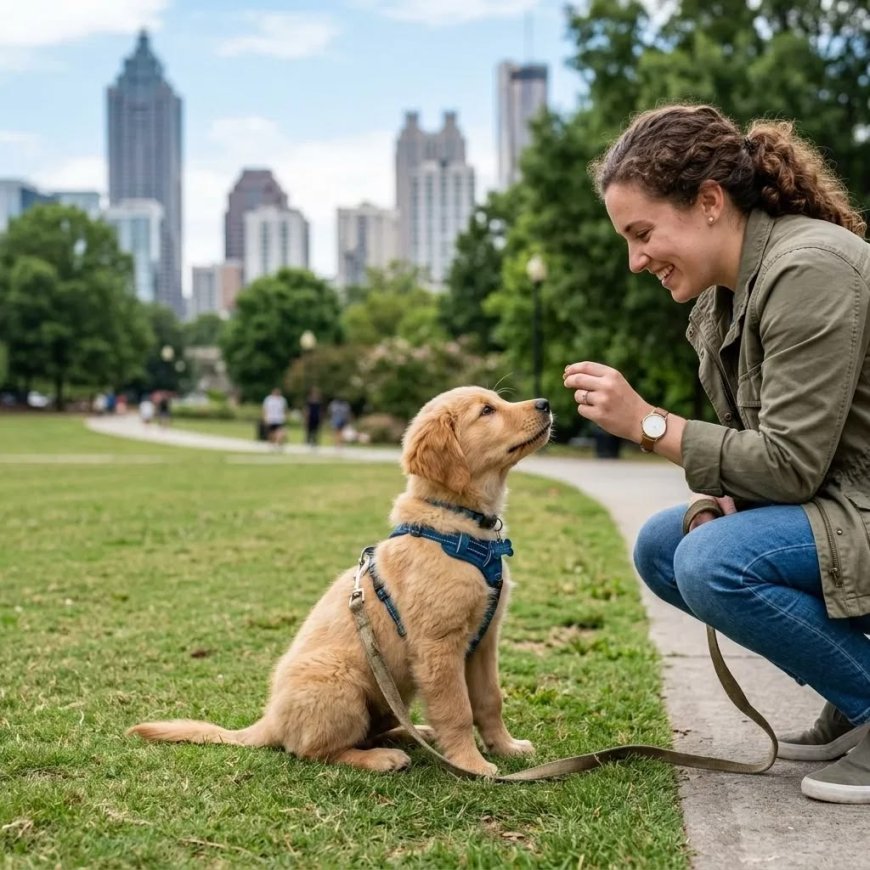
Everything you do in those first seven days sends a signal. The way you handle them when they're scared. How calm you stay when the crate crying starts at 2am. Whether you're consistent about taking them outside. Whether the energy in the house is steady or chaotic. Goldens read those signals from minute one, and they're building a picture of what to expect from you.
Ellie is a senior now, she's been with me through a lot. And I still think back to her first week. How much she just watched me. She followed me from room to room, sat and stared while I made coffee, flopped near my feet when I watched TV. She wasn't being clingy in the way people sometimes describe. She was studying me, taking in everything, building confidence from the fact that I was calm and consistent. We didn't overwhelm her with visitors or long car rides or a packed schedule. We just let her settle, gently.
Getting week one right, the small habits, the tone you set, the routine you start forming, matters more than any single training technique you'll use later. Start there.
FAQs
Is it normal for my Golden Retriever puppy to sleep so much in week one?
Yes, completely normal. Puppies at 8 weeks can sleep up to 18 hours a day. Their brains and bodies are growing fast, and adjusting to a new home takes real mental energy. As long as they're alert and active during wake periods and eating and drinking, that amount of sleep is healthy.
My puppy cried most of the night. Am I doing something wrong?
Not at all. Night crying in week one is nearly universal with Golden Retriever puppies. They've never slept alone and your puppy has no way of knowing yet that you'll still be there in the morning. Keeping the crate in your bedroom so they can hear and smell you helps significantly. Most puppies make real progress between nights four and seven.
When can I actually start training my Golden Retriever puppy?
You can introduce very basics like their name and a simple sit as early as week one, but keep it to two or three minutes at a time at most. Their attention span at this age is tiny. More structured, consistent training is more effective starting in weeks two and three once they've settled into the home and trust is building.
How often does a Golden Retriever puppy need to go outside in week one?
Every one to two hours during the day, plus immediately after waking, after every meal, and after any active play. 8-week-old puppies have very limited bladder control. Frequent outdoor trips and calm, positive praise when they go outside lay the foundation for house training. Expect accidents, expect them often, and just clean them up calmly without a reaction.
My puppy seems terrified of everything. Is that normal?
For some Golden puppies, yes. There's a developmental fear period that can start around 8 weeks, meaning new sights and sounds can startle them more than you'd expect. Don't force them toward things that scare them. Let them observe from a safe distance and build confidence at their own pace. Gentle, positive exposure without pressure is exactly what they need during this window.
Week one is a lot. For both of you. But somewhere in the middle of the exhaustion and the 3am wake-ups and the sharp little teeth, there are moments where that puppy looks at you and you can already tell what the next ten years are going to feel like. That part is pretty hard to describe.
What's Your Reaction?
 Like
0
Like
0
 Dislike
0
Dislike
0
 Love
0
Love
0
 Funny
0
Funny
0
 Angry
0
Angry
0
 Sad
0
Sad
0
 Wow
0
Wow
0