


















5 Golden Retriever Behavior Mistakes Owners Repeat

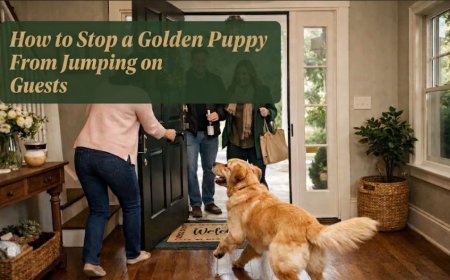
One of the first things I completely messed up with Ellie was the jumping.
She was eight weeks old, basically a fur tennis ball with floppy ears, and every time I came home she'd sprint to the door and launch herself at my shins. It was absolutely adorable. So I'd crouch down, let her climb all over me, and just laugh the whole time. No correction, no rules, just chaos in the best possible way.
Four months later, she was 30 pounds and still doing it. Guests were getting knocked over. My mom refused to come in through the front door. I had made this problem with my own hands.
That's the running theme with Golden Retriever behavior. So much of what owners struggle with, the jumping, the incessant nudging, the destruction that happens when you leave the house, it didn't come from nowhere. It started somewhere. A small choice, a habit formed during the puppy months, a response pattern that accidentally taught the dog what worked. At Golden Retriever Info, the behavior questions come up constantly, and when you trace most of them back, there's usually a moment early on where things went sideways without the owner even realizing it.
Here are five of the most repeated behavior mistakes I see with this breed, and more importantly, what's actually going on underneath them.
1. Letting the "She's Just a Puppy" Logic Run the House
This one is so, so easy to fall into. I say that as someone who fell directly into it.
A puppy jumping on guests, mouthing hands, stealing socks and running laps around the kitchen. These behaviors are normal in the first few months. The mistake isn't that they happen. The mistake is the logic of "she'll grow out of it" that lets them continue without any real redirection. Goldens don't automatically grow out of behaviors that are being reinforced. They grow into adult dogs who keep doing those things because, as far as they're concerned, those behaviors work.

Jumping got Ellie my attention. Mouthing got her a reaction. Stealing dish towels got her a five-minute chase session. From her perspective? Fantastic outcomes.
The rule has to exist from day one, even when it feels overly strict to enforce it with a twelve-week-old. If you don't want a 65-pound adult Golden jumping on people, you don't let the puppy jump on people. Full stop. If your puppy is already deep in this phase, the article on why Golden puppies bite absolutely everything breaks down what's driving that behavior and what actually needs to be addressed early versus what's genuinely just developmental.
Consistency isn't about being harsh with a puppy. It's just about being predictable. Golden Retrievers find predictability calming. Clear structure makes them more confident, not less.
2. Correcting Way Too Long After the Fact
You come home. There's a throw pillow destroyed across the living room floor. You know exactly who did it. You call her over and let her have it.
Here's the problem: your dog has absolutely no idea what you're upset about.

Dogs experience cause and effect in a window of about two seconds. After that, the moment is gone. By the time you've come home, noticed the pillow, and started the correction, your Golden has moved on from the pillow entirely. She's not standing there hoping you won't notice. She genuinely doesn't remember it. What she experiences in that moment is: you arrived, you called her to you, and now you're angry. That's the sequence she's learning from, not "I shouldn't chew the pillow" but something more like "coming when called sometimes ends badly."
The only corrections that actually teach anything are the ones that happen in the moment. Right as the behavior occurs, or within two seconds of it. If you missed that window, you missed it.
Clean up the mess, think about what led to it (too long alone, access to something she shouldn't have had, not enough stimulation that day), and prevent it from happening again. Scolding long after the fact doesn't teach the dog anything useful, it just stresses both of you out and can actually make her more anxious around you.
3. Turning Arrivals and Departures Into Events
Golden Retrievers are velcro dogs. That same quality that makes them so loving and emotionally tuned in to you also makes them prone to separation anxiety when the process of leaving and coming home is emotionally charged.
And most of us do this without thinking. Long goodbyes where we hold the dog's face and explain in great detail that we'll be back. Coming home and treating the reunion like something from a movie, full volume, lots of baby talk, immediate high-energy affection while the dog gets more and more frantic. Both of those things signal to your Golden that departures and arrivals are significant emotional events. Which is the exact opposite of what you want to communicate.
Dogs don't need fanfare to feel secure. What they need is calm, predictable energy from you. A low-key departure means you grab your bag and walk out without a production. A calm return means you come in, put your things down, maybe wait a couple of minutes before you greet her, and when you do, you keep it quiet. Wait for the four paws on the floor before any real attention happens.
If you're still putting the basics together with a new dog, the piece on 7 things nobody tells new Golden owners covers a lot of what the first few months actually look like, including how these habits form faster than people expect.
A calm goodbye isn't a cold goodbye. It's one of the kindest things you can do for a dog who already finds your absence stressful.
4. Accidentally Rewarding Demand Behavior
You're on a work call. Your Golden sits next to you and slides her nose under your hand. You pat her twice without thinking and keep talking. No big deal.
She does it again in twenty minutes. Then at dinner. Then she starts pawing your leg when the nose thing stops getting a response.
What happened is simple: it worked. She got a response, so she filed "nose under hand" into the category of behaviors that produce results. When that became less reliable, she escalated. That's not stubbornness. That's just learning, and she's actually quite good at it.
Golden Retrievers are persistent. And smart enough to try variations on a strategy until they land on what works. Give in to demand barking even once and the dog learns that barking long enough eventually pays off. Same with whining, pawing, incessant staring. The specific behavior matters less than the lesson being reinforced: if I try hard enough, I get what I want.
The fix is complete and total non-response to demand behaviors. Not a firm "no," because that's still a response and still rewards the behavior with attention. Just absolute silence, turning away, and waiting until the dog settles, then immediately rewarding that calm. You're not ignoring your dog. You're teaching her which version of herself earns attention.
Most people cave at least once before they figure out why the behavior is getting worse instead of better. If your puppy already feels like she's running the house, this breakdown of whether Golden Retriever puppies are too hyper or just normal can help you figure out what's breed-typical versus what's actually escalating.
5. Only Exercising the Body, Not the Brain
Goldens are sporting dogs. They were bred to retrieve game for hours over difficult terrain, which required physical stamina and a lot of active problem-solving. Most people know that this breed needs exercise. The part that gets left out is the mental side.
A physically tired Golden is not always a calm Golden. A dog who's been on a solid walk but hasn't had any mental engagement will still find ways to entertain herself, and those ways often involve your furniture or your garden or something else you'd rather she left alone.
(Side note: this is one of the things I wish someone had told me in year one with Ellie. I was so focused on getting enough physical exercise in that the brain piece didn't even occur to me until she was about a year old and I was genuinely stumped by how restless she still was. The article on why Golden puppies chew everything in sight actually touches on this directly, and reading it would have saved me a lot of frustration.)
Mental stimulation doesn't have to be elaborate. Ten or fifteen minutes of training practice, sniff games in the yard, a stuffed Kong, puzzle toys that make the dog work for her food. These things tap into a different kind of energy than a walk does. A Golden who gets physical exercise AND a training session AND a frozen Kong to finish her day is a fundamentally different dog to live with than one who only gets the walk.
That's not an exaggeration. Try it for a week and see what changes.
At a Glance: 5 Mistakes and What to Do Instead
| The Mistake | Why It Happens | The Fix |
|---|---|---|
| Letting puppy behaviors slide | "It's cute now" and "they'll grow out of it" | Set the rule from day one and hold it consistently |
| Correcting too late | You find the mess and react | Only correct in the moment (within 2 seconds) or skip it entirely |
| Emotional arrivals and departures | Natural instinct to show love | Practice calm, low-key hellos and goodbyes |
| Responding to demand behaviors | The behavior stops the noise | Complete non-response until calm, then reward the calm immediately |
| Physical exercise only | "This breed needs exercise" gets interpreted too narrowly | Add 10-15 minutes of training, puzzle work, or sniff games daily |
The thing about all of these mistakes is that they're genuinely easy to make. None of them come from not caring about your dog. They come from not knowing, or from the habits that form when life is busy and your Golden is adorable and it's just easier to let something slide this one time. Golden Retriever Info is a resource built around helping owners get past the guesswork, and a lot of what makes a difference isn't complicated. It's just being more intentional than most of us start out being.
If you're in the early months with a Golden, these are the things worth building correctly now, because they're significantly harder to undo later. You won't be perfect about it. I certainly wasn't. But 80 percent consistency, applied early, creates a very different dog than one who never had any real structure to work with.
And Ellie? She's nine years old now and finally, finally polite at the door. It only took me a couple of years of being more consistent than I was in the beginning. You can absolutely do better.
FAQs
Why does my Golden act out more right after I get home from a long day at work?
This is extremely common and it's basically pent-up energy releasing all at once. After hours alone, your Golden has been anticipating your return, and when you walk in that energy dumps out immediately. The fix isn't to ignore her but to greet her calmly, wait for the settling to happen, and then engage. Over a few weeks this becomes the expected routine and the frantic greeting at the door starts to tone down significantly.
Is using the word "no" bad for a Golden Retriever?
Not bad exactly, but limited. "No" works as an interrupter in the moment, it can stop the behavior right then. The problem is it doesn't tell the dog what to do instead, so they often just try something else. It's most useful when paired with a redirect right after: "no, sit" or "no, leave it." A Golden who only ever hears "no" without any guidance about what earns a yes tends to get confused more than corrected.
My Golden is two years old and still jumps. Is that fixable now?
Yes, completely. Adult Goldens are trainable, and because they're so food-motivated, retraining specific behaviors is very manageable. The biggest barrier is usually inconsistency across the household. If one person lets the jumping happen, the dog will try it with everyone because it works with at least one of you. Get everyone on the same page, apply the rule consistently for several weeks, and you'll see a real shift.
How long does it take to stop demand behaviors once you start ignoring them?
It depends on how long the behavior has been working. A demand habit that's been reinforced for months will take longer to extinguish than one you catch early. Expect it to get slightly worse before it gets better, because your dog will try harder when the strategy suddenly stops working. That's normal. Hold firm through that period and the behavior will drop off. Most owners see meaningful improvement within two to three weeks of true consistency.
Can a Golden Retriever be calm even with a long work schedule?
Yes, with the right setup. The key pieces are a solid morning routine that includes some training or mental work (not just a quick walk), something to occupy the brain during alone time like a Kong or puzzle feeder, and a calm re-entry when you get home. A dog who is left with nothing to do and nothing to chew will find something, and it usually won't be something you'd choose. But a dog who has a predictable structure and appropriate enrichment can handle a full workday reasonably well.
What's Your Reaction?
 Like
0
Like
0
 Dislike
0
Dislike
0
 Love
0
Love
0
 Funny
0
Funny
0
 Angry
0
Angry
0
 Sad
0
Sad
0
 Wow
0
Wow
0