

















Golden Retriever vs. Labrador: Which Is Easier to Own?

Almost every conversation I see about this starts from the same assumption: Labs are the easy choice, and Goldens are the slightly more demanding one. I've heard this framed so many times it's started to sound like settled fact. And honestly, there's a seed of truth in it. But it's also incomplete, and for some families it's outright wrong.
These two breeds are much more similar than the common wisdom suggests. Both are sporting dogs. Both are genuinely good-natured, smart, and social in ways that put most other breeds to shame. The differences exist, but they're narrower than people tend to expect, and which one is "easier" depends almost entirely on your specific household and lifestyle.
Rather than declaring a winner upfront, here's how they actually stack up category by category.
1. Grooming: The Most Obvious Difference, and the One Labs Win Clearly
This is the one area where Labs have a real, undeniable edge.
Labs have a short, dense double coat. A brush once or twice a week covers it. Goldens have a long, flowing double coat that mats more easily, collects debris on every walk, and needs brushing three to four times per week to stay tangle-free. Goldens also need occasional trimming around the ears, paws, and feathering on the legs and tail. If you're not doing it yourself, you're paying a groomer every six to eight weeks.

Both breeds shed heavily. This surprises a lot of Lab owners who assumed the shorter coat meant less shedding. It really doesn't. Labs blow their coat twice a year the same way Goldens do, the fur just presents differently. Golden hair is long and visible on dark furniture. Lab hair is short but embeds into fabric and carpet in a way that's genuinely harder to vacuum. Neither dog is low-maintenance in the shedding department. If you want to know what Golden shedding actually looks like across the year, the Golden shedding seasons guide on Golden Retriever Info lays it out clearly.
Bottom line: if you don't want a regular brushing routine, choose the Lab. If you don't mind it, the gap is smaller than most people think.
2. Energy and Exercise: Nearly Identical Needs, Slightly Different Timelines
Both breeds are high-energy working dogs. Neither one will thrive on a 20-minute walk and an afternoon on the couch. Plan on one to two hours of real activity per day for either of them.
Where they differ is in how long the high-intensity phase lasts. Labs tend to stay in what I'd call full chaos mode for the first two to four years. They're also physically less restrained about it. A young Lab jumps harder, runs faster, and seems genuinely unaware of how big they are. Goldens typically settle into a more manageable rhythm earlier, usually around 18 months to two years, though this varies a lot by individual dog.
One thing that catches both sets of owners off guard: these breeds need mental stimulation, not just exercise. A Lab or Golden who gets a long run but no brain engagement will still be destructive when they get home, just a tired version of destructive. If you're wondering what normal Golden energy levels actually look like during puppyhood, the Golden Retriever Info piece on whether your puppy is too hyper gives you a realistic baseline.
Both breeds: one to two hours of activity daily. Non-negotiable for either.
3. Training: Similar Ceiling, Different Approach
Stanley Coren's work on dog intelligence ranks Golden Retrievers fourth and Labrador Retrievers seventh out of 138 breeds. Both are exceptional. Both learn commands in fewer than five repetitions and obey known commands on the first try roughly 95% of the time. Either breed can be trained to a high level by a first-time owner with patience and consistency.
The real difference is sensitivity.
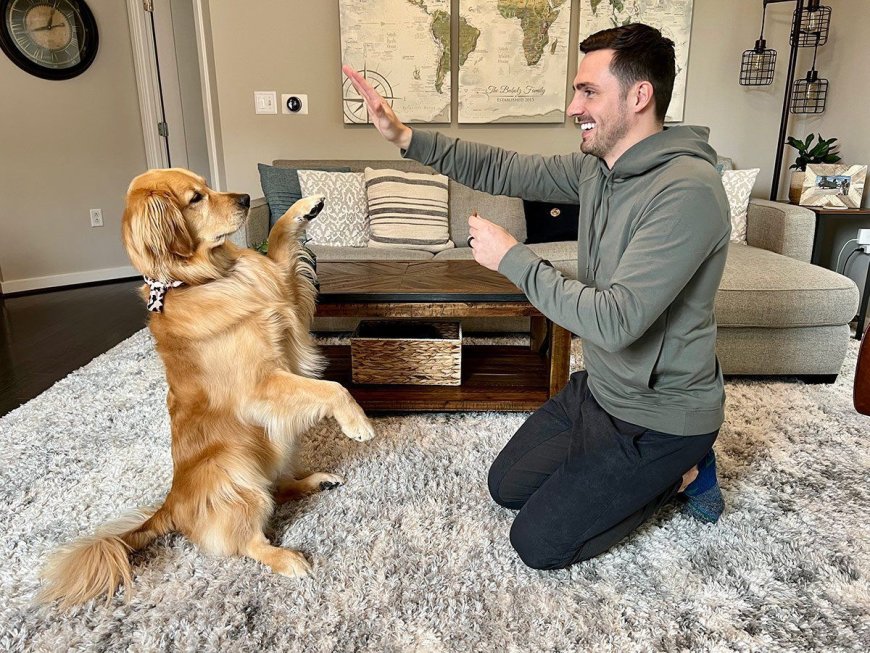
Goldens read their owners' emotional states with striking accuracy. A frustrated tone, a sharp correction, or a training session that ends badly can affect how they approach the next one. They remember bad experiences and they respond to them. Labs are not oblivious to tone, but they're more forgiving. A Lab bounces back from an inconsistent session faster. If you've never trained a dog before and aren't confident in your approach, the Lab's slightly higher tolerance for imperfect handling makes the learning curve a bit smoother.
But here's where this assumption gets people in trouble: Goldens are not easier to train in the sense that they somehow train themselves. An untrained Golden is still a 65-pound dog who jumps on guests, counter-surfs, and makes poor decisions about what counts as a chew toy. The training investment is similar for both breeds. The style is what shifts.
4. Emotional Needs and Alone Time: The Biggest Real Difference
This is the category that matters most and gets factored in least, at least in my experience of seeing new owners make this choice.
Goldens are what dog people call velcro dogs. They want to be near you. Not in the same room, near you. Following you down the hallway, settling at your feet while you work, making steady eye contact during your phone calls. Whether this is delightful or exhausting depends entirely on the person. Goldens also tend to be more attuned to emotional shifts in their household, they notice when something's off.
Labs love their people deeply, but they're a degree more self-sufficient. They'll settle on a bed and manage their own time. They tolerate reasonable stretches of alone time without the same level of distress that some Goldens experience. Not every Golden develops severe separation anxiety, but the breed is meaningfully more prone to it, and it's something to prepare for rather than assume won't happen. Golden Retriever Info's separation anxiety guide covers what this actually looks like in practice and what owners can do.
If you work full days and your dog will be alone for six or seven hours regularly, the Lab is probably the better fit. Not because Goldens can't adapt, but because they need more intentional support to do so.
5. Health and Vet Costs: Different Problems, Similar Bills
Both breeds average 10 to 12 years. Both have specific health vulnerabilities worth knowing before you commit.
Golden Retrievers carry a cancer risk that's significantly above the canine average. Around 60% of Goldens die from cancer, with hemangiosarcoma and lymphoma being the most common forms. This isn't a reason not to get a Golden, but it is a reason to go in with eyes open, to choose health-tested lines, and to build bi-annual vet visits into the plan once your dog passes seven.
Labs have a different profile. Their hunger drive doesn't have an off switch. Labs will eat past the point of discomfort and look for more, which makes obesity management a lifetime job. They also have elevated rates of hip and elbow dysplasia, and some lines carry a condition called exercise-induced collapse (EIC) that's testable through a reputable breeder. Neither breed is cheap to keep in good health, so budget similarly for both.
Golden Retriever vs. Labrador: At a Glance
| Category | Golden Retriever | Labrador Retriever |
|---|---|---|
| Grooming effort | High (3-4x brushing weekly, trimming) | Moderate (1-2x brushing weekly) |
| Shedding | Heavy; long visible fur | Heavy; short fur embeds in fabric |
| Energy timeline | High; usually calms around 18-24 months | High; may stay intense until 3-4 years |
| Trainability | Exceptional; sensitive to tone and mood | Exceptional; slightly more forgiving |
| Alone time | Lower tolerance; more separation anxiety risk | Moderate; more independent |
| Emotional neediness | High (velcro dog tendency) | Moderate |
| Cancer risk | ~60% cancer mortality rate | Below average for dogs |
| Obesity risk | Moderate | High (unstoppable hunger drive) |
| Grooming cost | Higher (professional grooming useful) | Lower |
| Average lifespan | 10-12 years | 10-12 years |
| Best fit | Present owners, active families | Varied households, busier schedules |
6. So Which One Is Actually Easier?
If easier means less coat maintenance: Lab.
If easier means less emotional investment and more independence: Lab again.
But if you're a first-time owner who's going to be home frequently, who wants a dog that bonds deeply and trains beautifully, and who is fine building a grooming routine into the week, a Golden isn't harder. It's just asking for different things.
The owners I've seen struggle most with Goldens are people who didn't account for the emotional presence the breed expects. A Golden isn't a dog you can set to autopilot during the week and fully engage with on weekends. They notice when you're not paying attention. That attunement is part of what makes them extraordinary. It's also what makes them a poor match for households where the dog has to be largely self-sufficient.
Lab owners more commonly struggle with the physical chaos of the first few years and the ongoing food management. A Lab will happily eat everything you put in front of it and start looking for more. The feeding discipline never really relaxes.
Neither of them is the easy choice, not the way a stuffed animal or a houseplant is easy. They're both real dogs with real needs and real personalities. The question is which set of needs fits your life better.
The Golden Retriever Info puppy checklist is worth reviewing either way. A lot of what the first few months require is the same for both breeds, and most people underestimate it regardless of which one they bring home.
FAQs
Are Labs really calmer than Goldens?
In the early years, often not. Labs tend to stay high-energy and physically exuberant longer than Goldens, sometimes until age three or four. Goldens typically start settling noticeably around 18 months. Both are active breeds that need significant daily exercise. Neither fits the "calm family dog" image until they've been through their high-energy phase.
Which breed sheds more?
They shed comparably in terms of volume, but the experience differs. Golden fur is longer and lands visibly on furniture and clothing. Lab fur is shorter but embeds into fabric and is harder to remove. Anyone who tells you Labs barely shed is working from one specific dog, not the breed in general.
I work full-time. Should I get a Lab instead of a Golden?
Probably, yes, if the choice is between an untouched Golden alone all day versus a Lab in the same situation. Labs manage alone time better by temperament. That said, a Golden with a midday break, a dog walker, or access to doggy daycare can absolutely thrive in a home where both owners work. The Golden just needs that support structure built in; it won't just figure it out on its own.
Which breed costs more overall?
Purchase prices from reputable breeders are similar for both, typically somewhere between one and three thousand dollars depending on the breeder and location. Ongoing costs diverge in grooming (higher for Goldens) and potentially in health care if cancer becomes a factor. Labs can rack up significant vet bills from joint issues and weight-related problems. Budget comparably for both and don't choose based on assumed lower costs.
Do Labs and Golden Retrievers get along well together?
Generally very well. Both breeds tend to be social and non-aggressive with other dogs. If you're considering getting both, they're one of the more naturally compatible pairings you could make. The energy levels are matched, the play styles are similar, and neither breed tends toward dominance in ways that create friction.
What's Your Reaction?
 Like
0
Like
0
 Dislike
0
Dislike
0
 Love
0
Love
0
 Funny
0
Funny
0
 Angry
0
Angry
0
 Sad
0
Sad
0
 Wow
0
Wow
0