




















Golden Retriever Info's Honest First-Time Owner Guide

I thought I'd done everything right. I'd read the books, watched hours of YouTube, ordered the crate, bought the enzymatic cleaner before Ellie even arrived, researched three different vets in my area. I made a spreadsheet, which in hindsight tells you everything you need to know about how prepared I felt versus how prepared I actually was.
And then she came home, and I realized fairly quickly that I had been preparing for a dog that didn't exist. The version in my head was calmer, slept more, and did not try to eat my baseboards on day four.
This guide isn't the polished version of first-time Golden ownership. It's the real one. The version I wish someone had handed me the week before pickup day, written by someone who had already made most of the mistakes on your behalf.
1. Before the Puppy Arrives, Adjust Your Expectations
The biggest gap between what first-time Golden owners expect and what they actually experience isn't about training or grooming or feeding schedules. It's about energy, and more specifically, it's about the kind of sustained, relentless, slightly chaotic energy a Golden Retriever puppy generates for the first twelve to eighteen months of their life.
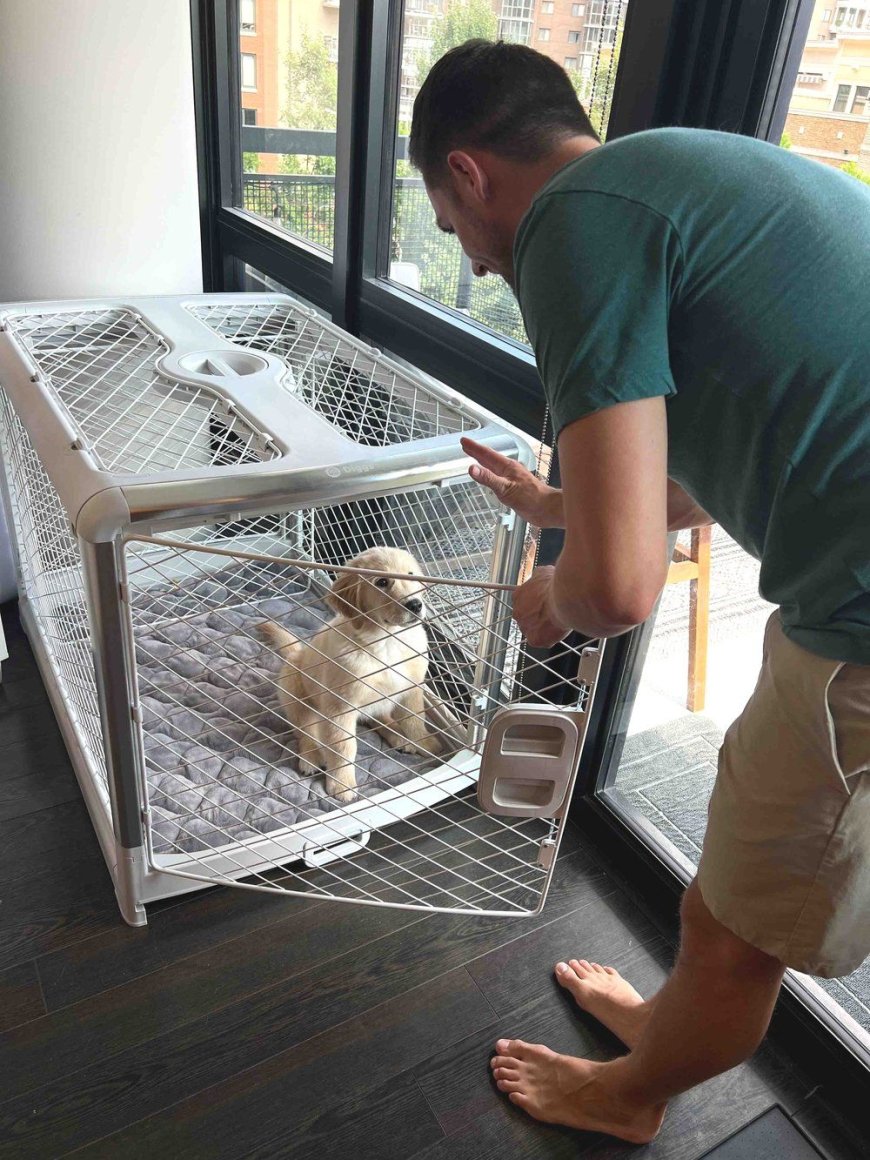
Goldens have an extraordinary reputation, and it's mostly deserved. They are genuinely affectionate, intelligent, and deeply committed to being near their people. But that same sociability, that same enthusiasm for connection, means that a young Golden left without enough mental engagement and physical activity doesn't quietly entertain itself in a corner. It finds something to do, and that something is usually your furniture, your socks, or the corner of your kitchen cabinet.
Before Ellie came home, I had prepared the space but not the schedule. I didn't think clearly about how much of my actual day she would need to be part of, how many small interactions and short training sessions and walks she would require to stay settled. I was thinking about puppies the way people who don't yet own them tend to think about puppies, as a sometimes-intense addition to an otherwise normal life. She was not an addition. She was the whole thing for a while.
The practical version of this: before your Golden arrives, think about your actual daily routine and figure out where the dog fits. Not ideally, but realistically. What happens on your longest work day? Who is responsible for the midday outing? Where will the puppy be when you're on a call you can't interrupt? Having answers to those questions ahead of time makes the first two weeks considerably less frantic.
2. The First Two Weeks Are Harder Than People Admit
Nobody lies about this on purpose. People just tend to remember the cute parts more vividly than they remember the exhaustion, and by the time they're telling you about their experience, the hard stuff has softened in the recollection.
The first two weeks with a new Golden puppy often include some or all of the following: a dog crying through the night in a crate they haven't accepted yet, mouthing that genuinely hurts because puppy teeth are small and extremely sharp, a couple of accidents per day even with diligent watching, and a level of supervision that feels closer to parenting a toddler than owning a pet. The golden part of Golden Retriever doesn't kick in immediately. You're in the puppy phase first, and the puppy phase is its own thing.
Ellie's first night home, she cried for most of it. I made the classic mistake of going in every time she made a sound, which taught her that crying produced my presence, which made things worse for several nights in a row. Getting crate training right from the beginning makes an enormous difference to how that first stretch of weeks feels for everyone, and the approach covered in the piece on crate training a Golden without the crying is genuinely close to what eventually worked for us.
The other thing people underestimate is the biting. Golden Retriever puppies mouth and chew constantly. It's normal, it's developmental, it's how they explore everything, and it still hurts and leaves little marks on your hands and wrists for weeks. The instinct is to yelp and pull away, which can sometimes ramp up the behavior rather than calm it. Redirecting to an appropriate toy, consistently, is slower but more effective. For a deeper look at why they do it and what actually works, the piece on why Golden puppies chew everything in sight breaks it down practically.
Week one is also when most new owners encounter their first moment of genuine panic about whether they made the right choice. I had mine on day three. Ellie had destroyed the corner of a dog bed, mouthed my hand hard enough to break skin, refused to walk back inside from the yard, and then sat in my lap and fell asleep as though none of it had happened, staring up at me with complete trust. That's the Golden Retriever experience distilled into a single afternoon.
3. The Adolescent Stage Is the Real Test
If the puppy phase is the steep hill, the adolescent stage is the part where you think you've crested it and then realize you haven't. Somewhere between six and eighteen months, most Golden Retrievers hit a period that can generously be called "finding themselves" and more accurately be described as selective hearing, dramatically increased energy, and occasional complete abandonment of commands they mastered two months earlier.
This is not a character flaw in your dog. It's a neurological phase. The same developmental period that produces teenage selective hearing in humans produces something similar in adolescent dogs. The training they've learned is there, wired in, but their impulse control is genuinely limited during this window. When Ellie hit this stage, I spent several weeks convinced I'd somehow undone everything we'd worked on. I hadn't. She came back to it. Most Goldens do.
The mistake owners make most often during this stage is backing off on training because it feels futile. It isn't. Short, consistent sessions kept during the adolescent months are what prevent the behavior from actually deteriorating to the point where it has to be rebuilt from scratch. Five minutes of sits, stays, and name recognition every day during a chaotic adolescent stretch does more than you'd expect.

The energy levels during this period also catch people off guard. A six-month-old Golden has more physical capacity than a twelve-week-old puppy and less ability to self-regulate. If you've been relying on short backyard sessions for exercise, you'll likely need to rethink that. Longer structured walks, fetch sessions, and mental stimulation through training and puzzle feeding all start to matter more here. It's also worth checking whether what you're seeing is actually hyperactivity or just an unmet need, the piece on whether a Golden puppy is too hyper or just normal goes into this in useful detail.
4. What Actually Changed Things for Us
I've tried a lot of things with Ellie over the years. Some of them made a noticeable difference immediately. Others felt useful in the moment but didn't hold. And a few things I thought were essential turned out not to matter much at all.
The one that genuinely changed how manageable life felt, and I almost hesitate to say this because it sounds too simple, was deciding that training wasn't a separate activity. It wasn't something that happened during a dedicated fifteen-minute session before dinner. It was just... the texture of the day. Asking for a sit before opening the back door. A quick "wait" at the bottom of the stairs. Reinforcing calm behavior when Ellie settled on her own without being told. None of these moments took more than five seconds. Together, they built a dog who understood that the basic rules applied all the time and not just during "training time."
The second thing was being much more consistent about not rewarding behavior I didn't want. This sounds obvious and I knew it intellectually, but there's a gap between knowing something and doing it when a fluffy Golden puppy is staring at you with absolute conviction that you should share your dinner. Goldens are extraordinarily good at being charming. That charm is part of their appeal and also one of the main ways they train their owners rather than the other way around.
The third thing was connecting with other Golden owners, people who knew the breed specifically, not just dog owners in general. There's information in a conversation with someone who has already raised a Golden through the adolescent stage that you won't find in a general dog training book, because the breed has genuine quirks that are worth knowing about. That's a big part of what Golden Retriever Info is built around, breed-specific knowledge from people who've actually been through it, not generic advice that could apply to any dog.
The first week, specifically, has its own particular shape, and the honest account of what it actually looks like is something a lot of new owners find genuinely reassuring to read beforehand. The piece on Golden Retriever puppy week one surprises is one I wish had existed when Ellie first came home.
What the First Year Actually Looks Like: A Realistic Timeline
WEEKS 1-2    Adjustment and survival mode. High supervision, some crying at night,
             lots of accidents, sharp puppy teeth. Normal and temporary.

WEEKS 3-8    Building routine. Potty training starting to take shape. First
             commands (sit, name recognition). Still mouthing constantly.
             Sleep improving but not consistent.

MONTHS 3-5   More settled at home. Beginning to generalize training to new
             locations. Leash walks becoming manageable. Shedding starting
             to pick up noticeably.

MONTHS 6-12  Adolescent stage hits. Energy peaks. Selective hearing appears.
             Physical size now demands physical exercise. Training feels
             inconsistent but keep going.

MONTHS 12-18 Starting to come out the other side. Better impulse control.
             Commands more reliable. Personality solidifying. The dog you
             were promised is becoming visible.

MONTHS 18+   Most owners find this is when Golden Retriever ownership really
             settles into what they imagined it would be: affectionate,
             responsive, genuinely good company.
Keep this somewhere visible during the first year. On the days that feel hard, it helps to know that what you're experiencing has a shape, and the shape has an end.
FAQs
Is it normal to feel completely overwhelmed in the first week?
Yes, genuinely. Almost every first-time Golden owner goes through a period in the first week or two of wondering what they've gotten into, especially people who had no previous dog experience. The gap between what you imagined and what a real puppy actually requires is almost always bigger than expected. It gets better, and it usually gets better faster than you think it will.
When does a Golden Retriever start to actually calm down?
Most owners notice a genuine shift somewhere around eighteen months to two years, though individual dogs vary. There are Goldens who mellow earlier and Goldens who stay puppy-brained until three. What you can count on is that consistent training, adequate daily exercise, and mental stimulation all move that timeline in a better direction.
How much daily exercise does a Golden puppy actually need?
The general guidance for puppies is roughly five minutes of structured exercise per month of age, twice a day. So a four-month-old puppy: two twenty-minute walks. This protects developing joints from the impact of excessive running on hard surfaces. Free play in a yard counts differently from structured walking. As they approach one year, that number increases and you can start adding more varied activities.
My Golden follows me everywhere. Is that a problem?
Following closely is normal Golden Retriever behavior, they're bred to work near their person and have a strong attachment drive. It becomes worth addressing if it tips into anxiety when you're not visible, or if the dog can't settle when left alone for reasonable periods. Mild velcro behavior in an otherwise confident dog is usually just the breed being the breed.
Should I take my Golden to puppy classes?
Yes, and mostly for the socialization rather than the formal training. Exposing a young Golden to other dogs, new people, and different environments during the socialization window (roughly three to fourteen weeks, with some extension to sixteen weeks) has lasting effects on temperament. The training itself can be done at home, but what a good puppy class provides in terms of safe social exposure is hard to replicate otherwise.
Ellie is a senior now. She moves a little slower on cold mornings, and she sleeps more than she used to, and sometimes I look at her and have a hard time connecting her to the puppy who ate half a bath mat and once managed to get stuck inside a laundry hamper. The chaos of those early months, the exhaustion, the moments of genuine doubt, those things faded. What stayed is the particular quiet she brings to a room, the way she always finds where I am in the house, the fact that after all these years she still wants to be wherever I am.
Nobody told me that was what I was getting into when I got a Golden Retriever. I wish they had. It would've made the hard parts easier to get through.
What's Your Reaction?
 Like
0
Like
0
 Dislike
0
Dislike
0
 Love
0
Love
0
 Funny
0
Funny
0
 Angry
0
Angry
0
 Sad
0
Sad
0
 Wow
0
Wow
0