




















Can Golden Retrievers Eat Carrots or Blueberries?

I used to hear it at the dog park all the time. Someone would spot me handing a piece of carrot to Ellie and immediately ask if I was giving her too much sugar. Another time it was blueberries, and a well-meaning stranger told me she thought those were on the avoid list for dogs.
Neither of those things is true. Carrots and blueberries are two of the safest, most nutritious snacks you can offer a Golden Retriever. The confusion mostly comes from people applying human diet anxieties to their dogs, or from stumbling across poorly sourced lists online that conflate "fruits safe for dogs" with "fruits safe for other animals." Grapes are genuinely toxic to dogs, and some owners extend that fear to all fruit. That's how we end up in conversations about dangerous blueberries at the dog park.
Both foods are safe. Both have real nutritional value. And here at Golden Retriever Info, these two come up in reader questions regularly, so it felt like time to address them properly.
1. Can Golden Retrievers Eat Carrots?
Short answer: yes. Confidently, cheerfully yes.
Ellie has been eating carrots since she was a small, relentlessly bitey puppy. I started with frozen slices during the teething phase, and the habit stuck because she loved them and I appreciated having something genuinely healthy to hand over when she was demanding a snack at 7am.
Nutritionally, carrots are worth paying attention to. Raw carrots are high in beta-carotene, which the body converts to vitamin A. Vitamin A supports eye health, immune function, and skin and coat condition in dogs. Carrots are also a decent source of fibre, vitamin K, and potassium. And they are low calorie. A medium carrot sits around 25 calories, which matters when you're managing a Golden's daily treat budget.
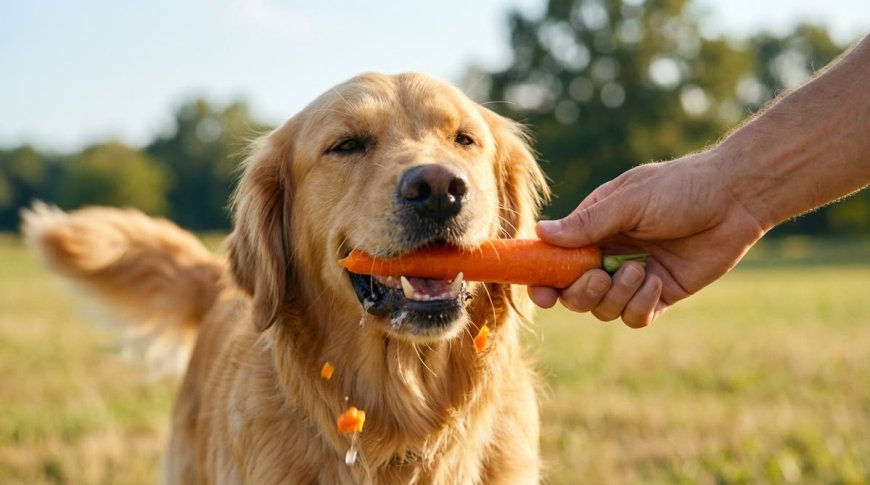
The dental benefit is real, though often overstated. I should be more precise about this: raw carrots provide some mechanical cleaning against light surface plaque as your Golden chews through them. That's a nice bonus. It's not a substitute for brushing or professional cleanings, not even close, but it's a useful supplement to a proper routine.
How to serve carrots:
Raw and cut into pieces is the standard approach. The size matters. A large adult Golden can handle carrot sticks or medallion-shaped rounds. Younger dogs or fast eaters should get smaller pieces, because a whole carrot disappearing at speed is a genuine choking risk.
Frozen slices are excellent for puppies in the teething phase. The cold reduces gum discomfort while giving them something safe to gnaw on. If your Golden puppy is currently chewing through everything in the house, the article on why Golden puppies bite absolutely everything covers that stage well, and frozen carrots are honestly one of the most practical things you can keep in the freezer during it.
Cooked carrots are also fine, as long as they're plain. No butter, salt, garlic, or any seasoning. Plain means plain.
One thing that comes up occasionally: carrot tops, the leafy green part, are safe for dogs too. Most Goldens find them too bitter to bother with, but worth knowing. It's a bit of a side note, but I've gotten that question more than once.
2. Can Golden Retrievers Eat Blueberries?

Also yes. And blueberries might actually be the stronger nutritional choice of the two.
They're loaded with antioxidants, particularly anthocyanins, the compounds responsible for their deep blue-purple colour. Antioxidants help protect cells from oxidative stress, and there's some research suggesting antioxidant-rich foods may support cognitive health in aging dogs. For a senior Golden, that's not a small consideration. Ellie is getting on in years now, and I pay more attention to what goes into her daily routine than I did when she was young.
Blueberries also contain vitamin C, vitamin K, manganese, and fibre. At roughly 84 calories per cup, you'd have to be handing them over by the fistful before the calorie count became a real issue.
What makes blueberries practically convenient: they're already the right size for most dogs. No chopping needed for adult Goldens. They're soft, they're small, and they work well as training treats or just a warm-weather snack. Frozen blueberries especially. I keep a bag in the freezer year-round. On hot afternoons Ellie gets a small handful and reacts like it's the greatest thing anyone has ever produced. It takes about ten seconds to prep.
For puppies, cutting them in half is a reasonable precaution. They're soft enough that choking is rarely a real concern, but it's a good habit to build.
And if you want to go one step further, try freezing them in a shallow tray with a little water. It keeps them occupied longer and works well for the warmer months.
3. How Much Is Actually Safe?
The standard guideline most vets use is the 10% rule: all treats combined should make up no more than 10% of your dog's daily caloric intake.
A healthy adult male Golden typically needs somewhere between 1,300 and 1,700 calories per day. That gives roughly 130 to 170 calories of treat room. A medium carrot runs about 25 calories. A small handful of blueberries, 15 to 20 berries, comes in around 12 to 15 calories. So there's actually generous room for both foods in one day.
Here's a quick-reference guide to help keep portions sensible:
| Life Stage | Weight (Approx.) | Carrots Per Day | Blueberries Per Day |
|---|---|---|---|
| Puppy (8-16 weeks) | 8-20 lbs | 2-3 small frozen slices | 2-3 berries, halved |
| Young Adult (6-18 months) | 40-65 lbs | 1 small-medium carrot | 10-12 berries |
| Adult (2-7 years) | 55-75 lbs | 1-2 medium carrots | 15-20 berries |
| Senior (8+ years) | 55-70 lbs | 1 soft or cooked carrot | 10-15 berries |
These are general starting points, not strict rules. Every dog is a little different. If your Golden is managing weight issues, joint problems, or any other health condition, it's worth checking the Golden Retriever Health section of this site and having a conversation with your vet before changing their snack routine significantly.
4. Where Golden Retriever Owners Usually Go Wrong
The most common mistake with blueberries is portion creep. Your Golden loves them, so the handful gets a little bigger each time, and before long they're getting close to half a cup per day. That much fibre hits some dogs like a freight train. Loose stools, stomach upset, general unhappiness. It sneaks up without you noticing it.
With carrots, the most frequent issue is size, handing a large raw carrot to a dog who doesn't chew carefully is a choking risk. It's an easy fix. Cut them up first.
A few other things that catch people off guard:
Cooked carrots from last night's roasted vegetable tray are not the same as plain carrots. Butter, salt, garlic, onion, any of these can harm dogs even in small amounts, and they find their way into carrot dishes constantly. Plain always means plain.
Blueberries from a muffin, smoothie, or flavoured yogurt are a completely different thing from fresh blueberries. The added sugar and other ingredients change the picture entirely. Fresh or plain frozen only.
And something that startles a lot of first-time owners: if your Golden eats a decent number of blueberries and their stool turns dark bluish-purple, that's completely normal. It's just the anthocyanin pigment passing through. It looks alarming. It isn't. Good to know before it happens so you don't panic.
If you're still getting familiar with what's generally safe for the breed and what to watch out for, the Golden Retriever Breed Knowledge section covers a lot of those foundational questions.
FAQs
1. Can Golden Retriever puppies eat carrots and blueberries?
Yes, both are safe for puppies with a couple of adjustments. For carrots, use frozen slices or very small cut pieces, which also helps with teething discomfort. For blueberries, halve them first. Start with small amounts and watch how their digestion handles it. Puppy stomachs can be more sensitive than adults, so introduce new foods gradually. The article on Golden Retriever Puppy Week One Surprises covers a lot of the early care questions that come up during those first weeks home.
2. Do carrots actually help a Golden Retriever's dental health?
They help a little. Chewing raw carrots provides some mechanical cleaning against light surface plaque, which is a real if modest benefit. They don't replace brushing or professional dental cleanings, and shouldn't be treated as a substitute for either. Think of them as a small bonus to a complete dental routine, not an alternative to one.
3. How many blueberries can a Golden Retriever safely eat per day?
For a healthy adult Golden, 15 to 20 berries is a reasonable daily amount, coming in around 12 to 15 calories. Going significantly beyond that on a regular basis can cause loose stools because of the fibre content. They're small enough that it's easy to overfeed without realising it, so it's worth keeping an eye on how many are actually going out.
4. Can I give my Golden baby carrots instead of regular ones?
Baby carrots are perfectly fine and convenient since they're already an appropriate size for most adult Goldens. They do have a slightly higher sugar concentration per bite than larger carrots, but for a healthy dog receiving normal amounts, that's not a meaningful concern.
5. What if my Golden eats too many blueberries at once?
The most likely result is digestive upset, including loose stools or increased gas, because of the fibre content. In most cases this resolves on its own within 24 hours. Dark-coloured stool from the pigment is normal. If your dog seems lethargic, is vomiting alongside the digestive issues, or symptoms persist beyond a day, that's worth a call to your vet.
Carrots and blueberries have both earned a permanent spot on my shopping list. They're affordable, easy to prepare, and Ellie treats them with the same enthusiasm she brings to every meal, which, if you know Goldens, means she acts like she hasn't eaten in three days.
The broader thing I'd say is this: whole-food snacks are almost always a better choice than commercial treats packed with additives, and these two are about as straightforward as it gets. Safe ingredients, real nutritional value, low calorie counts, and most Goldens actually want them. At Golden Retriever Info, practical guidance like this is what we're here for. No complicated protocols, no overthinking snack time. Just knowing what's safe, how much is sensible, and letting your Golden enjoy something good.
What's Your Reaction?
 Like
0
Like
0
 Dislike
0
Dislike
0
 Love
0
Love
0
 Funny
0
Funny
0
 Angry
0
Angry
0
 Sad
0
Sad
0
 Wow
0
Wow
0